Showing posts sorted by relevance for query jonathan bright. Sort by date Show all posts

Tuesday, 3 December 2013

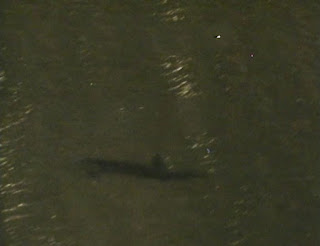
Analysis of the Jonathan Bright Picture

Two weeks ago I published the latest photograph of the Loch Ness Monster without much in the way of comment. Jonathan's story and photo have already been published in the latest issue of Fortean Times (No.308) and so now having had a closer look at the picture and the accompanying facts, let us see what else can be found out.

The photograph was taken by Jonathan Bright on the morning of the 2nd November 2011 as his ride on the Jacobite Cruiser boat was heading out towards Urquhart Bay. He was snapping pictures randomly with various cameras. As he was looking out from the stern of the boat, he snapped a series of pictures with his specially adapted infra-red camera but did not notice anything unusual at the time or even later, during his initial review of the pics. But it was a coincidence of the unexpected kind that prompted him to go back and check what he had.


For it was on that same day that George Edwards claimed to have taken his now infamous picture of a hump in Loch Ness. When Edwards' picture became news in August 2012 and thinking he might have taken pictures in that vicinity, Jonathan reviewed his snaps and did indeed find something unusual. However, what Jonathan Bright photographed is not what George Edwards photographed.


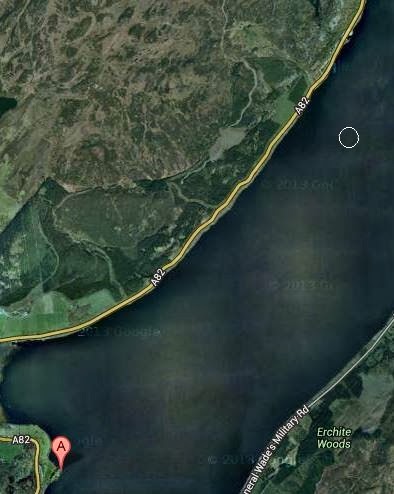
Based on what Jonathan has said, the picture was taken as the Jacobite was a few minutes out of the pier beside the Clansman Hotel and a suggested point is circled in the map below. The boat would be generally heading south west towards the vicinity of Urquhart Castle (marked A). The time would have been shortly after 11am when the tour boat departed from the harbour.


So what is in this first ever infra-red photograph of the mystery of Loch Ness? A zoom in of the picture reveals a bit more detail. In fact and in my opinion, it reveals something that looks out of the ordinary. But first, let us try and get some data out of this picture.


Jonathan kindly provided me with the uncropped image, the EXIF data and the model and make of his digital camera. From that an estimate of the object's size and distance can be made from the focal length, crop factor, distance to horizon, height of witness standing at the stern of the boat and relative distance of object to horizon.

That gave an object height of about 0.75 metre and a distance from the observer of about 31.5 metres. If we assume the object is turned at an angle of about 45 degrees to the observer, then the side aspect is estimated to be about 1.3 metres. This was based on the camera being 2.8 metres above the water. But a greater witness height would result in a bigger and more distant object and vice versa. So, for example, a combined witness/boat height of 3.5 metres gives an object height of 0.93m and a distance of 40 metres. If any wants the full trigonometrical calculations, send me an email.

So it is an object of some proportions but not as big as some Nessie sightings. But what are the possible candidates for such an object appearing on the surface of Loch Ness? Based on your comments to the previous posts, I address them here.


DEBRIS SUCH AS A LOG

Are we simply looking at a natural object such as a log or some man made rubbish? Apart from the shape of the object not suggesting the usual stuff that floats around Loch Ness, several other things dictated against this interpretation.

Firstly, Jonathan was on a boat ploughing through the water. I emailed Marcus Atkinson, who operates one of the large cruise boats at Loch Ness. I asked him what they do when an obstacle lies dead ahead of the boat.

He said they normally steer a course around it unless it is something minuscule such as twigs. So it is unlikely that such an object is going to end up only 31 metres behind the boat.

Secondly, once the object is avoided, the bow wave of the boat is going to be another reason why the object won't be so easily found right behind the boat. The reason being that the outward going bow wave will tend to push objects away from the boat's direction of travel.

Thirdly, even if the boat went over the object due to it being very low in the water, how come it manages to appear nearly a metre high on the other side? In the light of these propositions, I do not regard the debris as a valid theory. (Jacobite Cruises do have a catamaran boat which technically allows debris to pass underneath but it was not commissioned until 2012).


THE PASSING WAVE

The other explanation offered is that this is merely a wave. This might seem to carry more weight than floating logs. A quote from the Great Loch Ness Monster Debate Facebook page is appropriate here.

In my opinion, as a boat skipper who daily sees the waves made by the larger trip boats near Urquhart Castle, the "Nessie" photo is indistinguishable from the usual interference waves generated when the bow-wave from a south-west bound boat meets the north-east moving wind generated waves on an ordinary day. If someone offers a more logical explanation I will be pleased to learn from it.

So, be it logs or waves, the skeptics say their bit, mark it "solved" and move on (and let it be known that monsters do not constitute a "logical explanation"). Meanwhile, I had obtained the Fortean Times issue which carried the story of this photograph. Elsewhere in the issue, I came across a quote from Charles Fort which summed up it all up for me.

"When I see that a thing has been explained, I go on investigating."

So let's get on with the investigating. There are some reasons why I do not agree with this wave theory.

The person whom I quoted on waves is Dick Raynor. He has spent decades at the loch taking pictures of phenomena which can fool inexperienced observers of the loch. I looked at his web page on waves and wakes to see what his years of taking pictures has produced. I assume it was representative of his research on this topic. 

To put it bluntly, none of his photos look like the object in Jonathan's picture. But his quote says it is indistinguishable from the "usual interference waves" on the loch. I take the word "usual" to mean these are a common phenomenon, so he must have a better picture on file somewhere which matches Jonathan's picture.

In the meantime, the photos on his site show waves which are too flat, extended and appears together in sequential groups. Neither of these apply to the object in our picture which is more peaked and is on its own. I have scanned the uncropped picture and see no evidence of this being in those classes of wakes and waves. That is how we determine if it is distinguishable from the "usual" waves. The photograph below shows an actual Jacobite cruiser interacting with another boat wake. I see nothing in this picture to suggest the production of a stand out lone metre high wave.


Jonathan also sent me the photographs he took immediately before and after our main picture. The one below was taken seconds before and shows nothing.  However, I overlaid the Nessie picture over it and it just makes the right hand edge of the overlay. So, it is a matter of debate whether our object would have appeared in both pictures since its direction of travel is not clear.


Furthermore, the photo below which was taken after Nessie is too far to the observer's right hand side but is included to show the lack of any proposed interference waves. Readers may note unusual colouring of the pictures. This is because they were taken in infra-red. I have not come to any conclusion as to whether this adds to or takes away from the analysis of the picture.

Jonathan says it is a picture taken with τhe internal IR pass filter of his camera, which allows infrared light from 720 nM (the near infrared range extending from 700nM to 1000 or 1400nM, depending on the dividing system). So this is not in the thermal IR range beloved of Bigfoot Flir camera hunts. Jonathan's own comment on near IR suggests:

"The dark/light colors seem to rather depend on the composition of the surfaces, for example, healthy vegetation/chlorophyll reflects large amount of near-infrared light, thus giving the whitish appearance to the tree leaves and grass, while rocky surfaces reflect little nIR light. But I really don't know how a 'Loch Ness monster' body would behave."

Perhaps this is a clue which suggests the object in the picture is of a more rough texture. 


The other issue I noted was the height of the wave compared to others round about. Consider how waves normally interfere constructively to produce one bigger wave. The compound wave cannot be greater than the combined energies of its parent waves.  This wave looks at least twice as big as the waves around it which suggests another boat or wind source of comparable energy is nearby churning out waves.

There is no indication of such a thing in the picture. Indeed, the Jacobite cruisers are amongst the most powerful boats in the loch and, being November, I think the other cruises have closed out for the season. I am wondering what powerful boat could be around to provide this additional energy? Not that it matters, this "wave" does not look like such a wave. Jonathan also commented on how this "wave" seems to have water running off it as suggested by the white "streaks" you can see around its base.


OTHER CONSIDERATIONS

Could it be an animal known to science such as a seal? I do not consider this a seal as the back would look smoother and more rounded. Could it be a sturgeon? Well, despite the fact that such a sight would be extremely rare, I do not think an Atlantic Sturgeon could arch its back like that or display the contours I think I can see.

Finally, it was perhaps no surprise that it was suggested that Jonathan had faked the photograph via the ubiquitous Photoshop. Now, this gets trotted out now and again and I suspect without much in the way of analysis. But these type of images are becoming more and more prevalent and the Loch Ness researcher needs to be able to conversant with their tell tale signs.

But based on my conversations with Jonathan, he comes across as no faker to me. Moreover, to my less than expert eye, the image looks "in situ" based on contrast and light considerations. It is darker than the waves around it, but that is more an argument against it being a wave than a digital artifact.

Moreover, Jonathan is not a tourist seeking five minutes of fame. He is involved in various public events in Greece as a researcher and it would be plain stupid to put all this on the line for a fake photo. Indeed, why not make it a better photo and add a sequence if one was intent on fooling people?

Others may wish to comment, but please state your reasons rather than just state your opinion!


THE LOCH NESS MONSTER

So what could it be? How about I go out on a limb and suggest it is the Loch Ness Monster? Considering the estimated dimensions, this looks more like the head and neck of the creature than its main body. Jonathan has suggested he can see the head looking back at him but I have reservations about that interpretation. In fact, to me the object looks somewhat similar to the photo taken by Sidney Wilson back in 2007 (below). However, I think Jonathan's is a better picture and again we have to be wary of the effects of pareidolia. Indeed, the Wilson image looks like a polar bear's head to me!


I do agree with Jonathan that the picture could be interpreted as a head with two white horn-like projections being visible. It could even be argued that two eyes can be made out and a muzzle of some description. What can be seen is to some extent dictated by the viewer.

But in my opinion, the proposed head is too large to fit what we know about the head and neck of the Monster from the witness database. By and large, the classic head is lacking in features and sometimes is no more than a continuation of the neck. I say that without going into detail about what this "head" may actually be. Moreover, the proposed head gives the impression of looking back in the direction it appears to be travelling in which looks quite un-animal like behaviour to me.

The other question to ask is how big the entire creature is for a head in this size range? Now when I say the head is too big, I mean in terms of internal proportions rather than absolute size. If we assume a 0.6m (1ft11in) head height from the picture, I would estimate the entire size based on a rough and ready plesiosaur body shape to be 12:1 overall giving us a 23 footer (a respectable size for a Loch Ness Monster).

Jonathan is a member of the sizeable community of paranormal researchers and is open to such an interpretation for Nessie, so that does offer a wider latitude in interpreting the picture.  However, there are some recorded sightings which claim to see larger heads and I would neither wish to be dogmatic or claim the final word on that matter. In fact, the head and neck reported by J.M. Ballantyne in 1965 is a good example in that regard (sketch below).


On the subject of backs, there was one back sighting that immediately came to mind when I saw this picture and that was the Commander Meiklem report from August 1933. He saw a ridged back in the relatively shallow waters of Inchnacardoch Bay. I say that because there is the appearance of something ridge-like running along the top of the object.


But Meiklem's object was at least the size of a "cart-horse", this is a lot smaller. Back ridges are occasionally reported by witnesses but they are not a universal feature of Nessie morphology which leads me to speculate whether it is a feature that is specific to age, gender or season.

Or could it be the back of a juvenile Nessie? If we know little about the Loch Ness Monster, then we know even less about alleged little Nessies. Do they even exist? One presumes so biologically but next to nothing can be said about them from the witness record. I addressed this subject in a previous article.

But if I suggest that this is the rear view of the head and neck then could the proposed ridge be more akin to the mane of the legendary water horse? Again, we have reports of mane like structures being reported by witnesses. And again, they are not a universal feature of the witness record and so I presume they are also gender, age or season specific. The problem is similar to the old tale of the blind men and the elephant. What exactly are we looking at? Neck, back or perhaps even tail?

One aspect of reported manes is that they tend to "flop" down over the neck while this apparent mane looks more erect. Can these mane like structure be raised in the manner of a courtship or territorial display? Yes, I know, speculation.

It is this mane or ridge like structure that distinguishes the object from any proposed wave, log or other object but the picture highlights an ongoing issue. This was taken at a mere range of about 100 feet but still there is no unambiguous data to extract. By unambiguous, I mean acceptable even to sceptics (but perhaps I use that term too optimistically).

Admittedly, the object's relatively small size is a hindrance, but how close does one have to get to this creature to get the picture that gets the whole world talking? If it had been a classic ten foot hump then we would get closer to that scenario.

In conclusion, I think this is a picture of the Loch Ness Monster. I think it tells Nessie researchers a bit more about the creature's morphology but does not provide the slam dunk evidence.

To rephrase some words mentioned above, if someone offers a more logical explanation I will be pleased to learn from it.


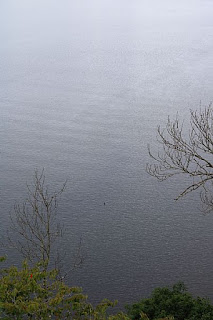
Friday, 7 November 2014

Jonathan Bright Photo goes Mainstream


I am glad to see that Jonathan Bright's photo of Nessie has gone live on the mainstream media. The major papers are running it now as you can see below.


My original article on Jonathan's picture was top google hit for this picture, but that won't last long as people visit these sites for the latest evidence of Nessie. Well done, Jonathan, on raising Nessie awareness. And, no, I do not think it is a wave.

P.S. We have had innumerable comments by sceptics that this is a wave. More than enough in fact, so let this picture bask in its temporary glory ... so no comments for this article.


Sunday, 2 March 2014

Jonathan Bright on his Loch Ness Monster Photograph


I have already covered Jonathan's picture taken in 2012 in a previous post. But Jonathan now brings his own story and thoughts to the table in this blog posting. He has also put up an accompanying YouTube video (below). Jonathan delves into the paranormal aspects of Nessie theorising, of which I am sure there are plenty of advocates. I used to believe in this theory (since I believe in paranormal phenomena in general), but have since decided to pursue the biological side of things. 

Of course, we hear of strange things going on around Loch Ness which are suggestive of such things. We read of the strange events that Tim Dinsdale recorded which were not Nessie related (I would love to see that journal). Also, Ted Holiday's strange goings on surrounding the 1973 exorcism of Loch Ness also raises the eyebrow.

Though Jonathan brings in the magician, Aleister Crowley, it is a fact that monster reports and legends preceded his arrival at Loch Ness in Edwardian times by a long stretch. But paranormalists may argue that what ever "portal" attracted Crowley there, was the same progenitor of Nessie. Indeed, it is a bit unclear why Crowley selected Boleskine House at Loch Ness. The house configuration he demanded could have been fulfilled in any number of areas, but why this particular area?

Interesting questions, but again, just at the edge of reality's peripheral vision. The hunt continues, I hope to be at Loch Ness in about a month's time!


Wednesday, 13 November 2013

The Jonathan Bright Nessie Picture


I got a heads up that the latest issue of Fortean Times was publishing a new story on a Loch Ness Monster photograph. It was taken by Jonathan Bright who was on a mystery tour of Britain back in November 2011. If you want the full story, get the latest issue of Fortean Times (number 308).

What do readers make of it? Is it a ridged back or a head-neck with a mane like appearance in true Water Horse fashion? On the other hand, sceptics may think it is just a wave, debris or a hoax. I will put up my analysis in due course.

All I will say just now is that if it is a picture of the Loch Ness Monster, it is one of the best (and the first taken in infra-red).


Saturday, 27 December 2014

Nessie Review of 2014

Recollecting the events of 2014, let us look back on the Loch Ness Monster and those who claimed to have seen or represented Scotland's most famous inhabitant.

As the Referendum on whether Scotland should be an independent nation approached, it was less than seriously suggested that there would be no Nessie to spot as various cartoons were published showing Nessie heading south for more stable waters.

Not that I would blame her for making that decision, but as it turned out, there was no need to panic as Scotland remained in the Union. Below is one example of the Loch Ness Monster cartoons that amused us during some tiresome and heated campaigning. Shades of Godzilla!


Nessie, as a major Scottish icon, also made an appearance at the successful Commonwealth Games in Glasgow during the August Opening Ceremony. You can't keep a good monster down! However, I think the hybrid tyre form is a reminder that not all things we see are necessarily the Loch Ness Monster.


But what of the creature itself? Back in April, the newspapers got a bit heated about an object that had appeared on Apple's satellite images of Loch Ness. I actually covered this image at the tail end of 2013, but it took a few months for it to be picked up by the wider media. The consensus definitely moved towards this being one of the Jacobite cruise ships, albeit it looked a bit odder than previous images.


Following hot on the heels of this satellite image was a sonar image that raised eyebrows only days later. It was recorded in Urquhart Bay by one of the aforementioned Jacobite cruise ships. The object was about 30 feet below and registered a signal stronger than that the similar crescent shape we would see for the swim bladders of fish. Was it the monster, a seal, a sonar recording anomaly or something else? No seal was reported in Loch Ness and one is left in an inconclusive state as to what was registered that day.


Consulting Gary Campbell's web log of sightings, two other stories come to the fore. The first was an object seen on Google Earth by Bjarne Sjöstrand, once again in April. You can see the vertical filament object at coordinates 57°10'25.30"N, 4°36'53.53"W just off the Horseshoe Scree. It is just above the centre point on the image below.


Now, we have seen similar objects on Google Earth before back in 2011 and were non-committal on them, mainly because they were un-Nessie like in their shapes. This one looks no different. However, we did have two more traditional sightings from people who spotted strange objects from their vantage points on the loch shore.

Referring to Gary Campbell again, nine people watched an object and its wake from Brackla on the 20th May about 10am. They watched it for 15 minutes before it submerged. Photographs were taken, but at over a kilometre away, these are inconclusive.

Eighteen days previously (May 2nd), a local gamekeeper is said to have watched an object at the head of a 50 foot wake progress southwards from Dores. He is stated as saying it was

 .. an amazing sight. I travel this road to Whitebridge daily and have never seen anything like it.

However, neither of these accounts made it into the newspapers. The bottom line these days appears to be, "No Picture, No Story", and by that we mean a semi-decent image. Thankfully, we have people that still collect these verbal accounts for the record.

This year was also the year that Jonathan Bright's hump photograph went viral at the time of the Scottish Paranormal Festival in October. And, no, I don't think it is a wave.

But, in keeping with the Loch Ness Monster, we did have our false alarms. In November, a local by the name of Richard Collis filmed an object looking like a long neck sticking out of the water. Not committing to anything until the witness was spoken to, our own man on the spot, Jonathan Bright, was on the case within hours, and revealed it was no more than a lifeless object, perhaps a branch or something else.


In fact, I was told recently that the object is still there and is probably not a branch but a human artifact, such as a boat part. The main thing is, it lingered, and real Nessies tend not to hang around!

We also had a blast from the past in October as archive research by David Clarke revealed that there was a monster battle in 1934 when Nessie fever was high. An academic tussle arose between the Natural History Museum in England and the Royal Scottish Museum for the rights to the carcass of the Loch Ness Monster. Was Nessie a British monster or a Scottish monster? An appropriate topic in this year when Scotland decided its national fate.

Back in 1934, they never had the opportunity to put it to the test. Let's see what 2015 brings!


Sunday, 2 November 2014

A Day At The Scottish Paranormal Festival


It was off to Stirling this Friday as I made the short trip from Edinburgh for a day of paranormal lectures with Nessie surfacing somewhere along the line. The event was into its second of four days at the Albert Halls just outside the town centre.

I bought a whole day pass which gained me entrance to the day's five lectures, starting with our very own cryptid at 10am. The speaker was Jonathan Bright, who will be familiar to regulars here as the taker of an alleged photograph of Nessie back in 2011. I say alleged because not all agree on the identity of the object in the picture. This blog takes the view that it is Nessie, others interpret it as a wave.

Jonathan gave some background on his own general, paranormal investigations at home (in Greece) and beyond. But his photo took pride of place in the presentation as Jonathan discussed how he saw a horse like head in the picture which followed in the tradition of the good old water horse of old. He then went through the various ways in which the Loch Ness Monster could be interpreted as a paranormal phenomenon. I'll develop that more as I describe the day.

The second talk by Jonathan Downes on the Chupacabra was cancelled. I don't know why and I was disappointed not to hear and meet Jon for the first time. As a result of this gap, the Q&A session for the Loch Ness Monster talked was extended.

After this, the third scheduled talk was by the "Paranormal Contractor", Stephen Mera. This concerned his various call outs to investigate strange goings on across Britain.There was no theory here but a series of tales of his adventures as he came across phenomena which were explicable and inexplicable. Swinging lights were explained by a kid with a yo-yo, but water which was observed to travel across a ceiling like a snake and drop down like rain was beyond his powers of deduction.

Equally, if not more compelling was the talk by Nick Kyle of the Scottish Society for Psychical Research. Ironically, he was a replacement for another call-off, Hayley Stevens, who is a ghost-hunting sceptic. I say ironic because Nck is the opposite of Hayley in his conclusions. Some fascinating tales, pictures and audios made for an interesting case for phenomena which require an explanation beyond what the sceptics normally offer. Then again, I have not read their explanations for these events and so will say no more.

The final talk of the day was by Peter McCue and entitled "Orchestrations of the Trickster". This took me back to the musings of Charles Fort, from whom we derive the word "Fortean". Fort speculated on whether the odd stories he had compiled over the years were evidence of a Cosmic Trickster playing tricks on mankind. 

How much Fort believed this I don't know, but Peter McCue brought it up to date by suggesting phenomena such as UFOs, Bigfoot and Poltergeist activity had the same origin in a higher intelligence. By implication, this would extend to other cryptids. This is not a new theory, but it still baffles me as to the motives of such a "Trickster" who persists in this apparently puerile behaviour for millenia. Suggestions are welcome.

So ended an interesting day, but how applicable was all this to the Loch Ness Monster? Firstly, I would say that Nessie hunters of the past such as Tim Dinsdale and Ted Holiday would have been quite at home with these proceedings and would happily have taken their seats here. Indeed, seeing one or both of them presenting a talk would not have been out of the question.

There are a plurality of readers of this blog who subscribe to a paranormal Loch Ness Monster. Again, they would have no problem turning up at such a conference. But quite how this all hangs together is vague (to me at least).

I, myself, believe in paranormal phenomena and have even subscribed to a paranormal Nessie in the past. From what I discerned this Friday past, it is not clear whether that theory has developed much. To take a paranormal position will get rid of supposed problems such as food supply and the lack of a carcass. However, to say Nessie is a solidified thought form looks as easy to say as the sceptics saying Greta Finlay only saw a deer. Easy to say, but how do you convince those outside your "camp" of this?

Perhaps a more solid theory explaining this will be forthcoming, in which case I will pay more attention. In the meantime, you are free to post your musings and theories.

On a final note, I talked to Malcolm Robinson, who has written various books on strange phenomena. He tells me that he hopes to publish a new book on the Loch Ness Monster entitled "The Monsters of Loch Ness" by the end of the year. I look forward to that, though note this is the same title as the late Roy Mackal's book. Can you do that?

And to finally bring this article back to the blog's position, Malcolm agrees with me that Nessie is a water breathing animal!


Saturday, 13 September 2014

Two Forthcoming Lectures on the Loch Ness Monster

I would like to publicise two talks on Nessie which are coming over the next two months. 

The first is part of the Scottish Paranormal Festival which runs in Stirling, Scotland from the 30th October to the 2nd of November. The talk is by our old associate Jonathan Bright who took that controversial picture of what may be the Loch Ness Monster which was analysed on this blog. My own take is that this is the creature. Other have differed and think it is a wave, but I beg to differ.


Jonathan will be giving his views on how the Loch Ness Monster could be viewed as a paranormal phenomenon as well as looking back at his photo and some other items. The talk is at 10am on the 31st October and you can find further details here. Click through to the other talks at the Festival, you may find other things of interest to you.

The second talk is on the 11th November at 7:30pm in which Charles Paxton gives the Edinburgh Fortean Society an update on his statistical analysis of Loch Ness Monster reports. Charles has been working on a project to perform an in-depth analysis of all the monster reports he could find going back to centuries past.

I have had access to this database and it is quite comprehensive and Charles has some results to share from it (though not all of them). I suspect there may be something for both the pro- and anti-monster groups, but we shall see. Charles hopes to publish some more detailed papers in the months ahead. Check out the website of the EFS for updates.

I hope to be at both meetings, so it would be nice to meet up with any regulars (even sceptical ones!) who make it to these events.


Tuesday, 28 December 2021

Nessie Review of 2021


It is time to look back on the year past and so let us get straight into the recorded sightings via Gary Campbell's sightings register. This records six sightings for the year which compares to eight in 2020 and thirteen in 2019. Now not every account will turn out to be the monster, let everyone judge and be persuaded in their own mind. In fact, to this day, there is no such thing as a "confirmed" sighting as there is no agreed benchmark by which to measure such accounts and who would be the judge that chooses the ruler to perform the measurement? In my mind there are sightings that are beyond my reasonable doubt, but that will not be the case for others.

I would categorize four as single humps, one as a water disturbance and the last was detected underwater on sonar. Three had photographs and one included a sketch. The quality of the photographs are not good and again exemplify the problem of photography at the loch with mobile phone cameras - assuming these were the devices in use. The image below taken by Thomas Dobinson on the 30th July drives home the point.


The witness states that the dark coloured object below the castle was about two hundred yards away and the size of a dog. One may churlishly ask what kind of dog - a great dane or a chihuahua? If we assume a typical mutt then we are talking about two to three feet across. If we triple this to represent the six to nine feet of hump that would break the surface for an eighteen to twenty seven foot monster, even that would not look great on such a photograph - and this is a distance one may expect some clarity. But, no, assuming these estimates are correct, even a close up of a large creature may not cut the mustard due to the poor lens and aperture involved.

Remember, mobile phones are for close up friends and family or huge buildings, mountains and so on. I do not think I have seen a decent defensible picture of the monster since 2016 and the Kate Powell fin-like object. Before that we may go back to Bill Jobes and Jonathan Bright around ten years ago. Have mobile phones made the situation worse as people ditch decent cameras for them? I don't know, but it is a subject for discussion.

One report that I rank higher was by Colin Veacock on the 30th July. I have read the reports in the media, but I know Colin from his previous postings as a Nessie fan on Steve Feltham's Facebook group. Colin said the newspaper reports got various things wrong, so I lifted his own account given in fragments and reproduce it here.

I was scanning up and down the loch north of the castle when on my third pass I noticed this object about two thirds of the way across the loch. It was suddenly just there. I didn't, as one site put it, see a prehistoric monster surge out of the water! At first I thought it was small but later when the Jacobite Warrior passed I got a better idea of scale. It was two feet high, ten to twelve foot long and tapered away into the water. I came to that estimate by judging it was the same size as the handrail at the rear of the Warrior. A black dinghy speedboat passed close but it never moved. An Indian couple parked on my right followed my directions and gave me a thumbs up indicating he could see it. Then the clouds broke bathing the opposite shore and hills in bright sunlight and I lost sight of it in the reflections in the water. I didn't, as one site said, see it plunge into the peaty depths, I just lost sight of it.

... I think it was an animal but not prehistoric. Got to admit though, while watching it I was hoping the classic neck and head would pop up.

... I've always thought that 'Nessie' is something completely knew. Something we haven't come across before due to it spending most of its time in the deep water. I also think its the same species of animal spotted in other bodies of water at that latitude.

... It was just too far away. It was the same size as the handrail at the rear of the Jacobite Warrior. Besides which, every time I looked away it took me a while to relocate it. I should say as well, I thought it was much smaller until the boat came along and gave me a better understanding of the scale and distance involved.


Colin provided a sketch shown here. When I saw this, I thought to myself, where have I seen this before? The high end and the tapering hump evoked a memory of another sighting separated by decades but connected by similarity. The answer came from Rupert T. Gould a mere eighty eight years before and the witness was a Mr. W. D. H. Moir near Inchnacardoch Bay on the 26th August 1933 about 9:15pm. The text from Gould is below.


Mr. Moir was walking from Fort Augustus along the road running towards Port Clair, which skirts Inchnacardoch Bay. Just after he had passed Cherry Island, he noticed a " powerful wash" in the Loch, and observed an object heading to pass close to the far side of the island. He took it at first to be a boat hurrying for the Canal lock - whose gates, at that time, were closed at 9 p.m. As to the visibility, he remarks : "At the time . . . the sun was setting behind the hills, casting bright reflecting lights high over the Loch and the tree-tops, while the water was dead calm."

The object passed "dangerously close" to the far side of Cherry Island, and headed into Inchnacardoch Bay. By this time Mr. Moir - who, having heard no sound of oars or engine, had concluded that it was not a boat - had turned round and was walking back towards the bay. When within the bay it slowed down and appeared to roll from side to side, causing a "rolling wash" which spread until it reached the shore. Suspecting that he was looking at X, he left the road and went down towards the shore for a closer view - managing to get within, as he estimates, 200 yards of it. ...

Two points chiefly surprised him - X's colour, and its size. He had gathered, from previous accounts, that X was black, or almost so - whereas it appeared to him to be brown, "with a tendency to changing colours of a lighter nature, nearer the surface of the water." And he estimated the length of the portion visible to him at 40 feet. Somewhat resembling an upturned boat, it rose moderately sharply to a height of some 5 feet above water at about the same distance from the rear end, and then sloped gently down towards the front ... As he saw neither head nor tail, he concluded that the total length could scarcely be less than 50 feet. [He had X in view for four to five minutes.] He started to walk back towards Fort Augustus; hoping to get a lift on the way, collect his camera, and return to photograph X. After he had gone some distance, he noticed that the time was 9:30, and decided that the chance of getting a photograph was remote. He therefore returned  - but discovered, on coming in sight of the bay, that X had disappeared. 


Two differences between 1933 and 2021 was that Moir's creature was more than three times longer. The other was that the Moir creature was moving whereas Colin's did not seem to budge an inch. Note that the Monster continues to surprise. If one had been asked to guess what direction the creature would move, you may have said right to left as you assumed the raised portion was the shoulders and the back receded down to the submerged tail. But, no, it heads off tapered end first. Would Colin's object have moved in a similar fashion? 

The length to height ratio of the Moir monster was 8:1. Colin estimated his as between 10:1 and 6.7:1 which averages to 8.3:1  - very close to the Moir account. As stated above, Colin was less in accord with the journalists who typed up his account:

Since this sighting the reporters have driven me to the point of madness. Only one swapped an email with me. The rest just exaggerated and right out lied about what I saw. Seems if you're a reporter and you're going to write up a piece on Loch Ness, you either exaggerate and blow it out of all proportion, or you ridicule it and belittle the sighting - but what they don't do is just honestly report the facts.

One argument of the sceptics is that journalists take mundane accounts and spice them up to monstrous levels. In other words, the original account would have been easily explicable if known. It is an attempt to tar and brush many an eyewitness story in one sweeping generalization. As we can see here, they do exaggerate, but the original account is good enough to avoid simplistic dismissal.

Indeed, Gould himself re-interviewed many a witness who were previously published and found them still to be noteable accounts. One final observation is that the Veacock and Dobinson accounts happened on the same day separated by three and a half hours and perhaps less than a mile apart (perhaps Colin could verify that). Maybe that is just coincidence or perhaps it lends mutual credibility. 

The sonar image was discussed in this blog only a few weeks ago at this link. It is a good account by Benjamin Scanlon allied with the boat captain, Mike Bell. I discussed the matter with Mike and felt it was an object of some considerable dimensions, though what exactly those were and what the actual morphology of the object was were beyond the capability of the sonar device. I assume that we will be getting a few more of these images in the year ahead of us.

The third class of account now merits its own section on Gary's sightings website and that is the genre of webcam video images. Gary numbers them at ten for the year compared to five local sightings and one sonar scan. Five were by regular webcam watcher Eoin Fagan, two by Kalynn Wangle, and one by Weiming Jiang, Matt Reddick and Roslyn Casey. Now the regular charge is that these images are just specks of not real use. I wouldn't disagree much with that, but when I checked the three photos we have of the local surface sightings, they were no better, perhaps worse!

That's not the fault of any person, they can only work with the tools they have. But perhaps some hope is at hand as Steve Feltham is looking into installing a webcam from his home on Dores Bay or perhaps somewhere close by. Obviously as close to the loch as possible is high on the list, but I would also suggest a bit of elevation as well and a good HD resolution. Other higher cost questions may be infra red night vision, slow panning to cover more loch and zoom. I have no idea how feasible all of that is.

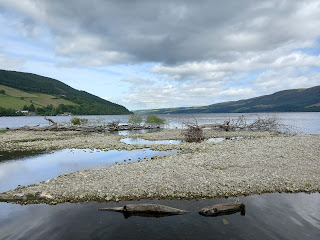
So much for the sightings log, what about research on this blog? The main breakthrough was finding the Sidney Wignall aerial film of something in Loch Morar. It took a bit of digging and luck but I got some images out there and the object itself (below). However, I concluded I was as ambiguous as Sidney was as to the object's identity. For now, I will say tree log, and hope to investigate it on site in the year ahead.


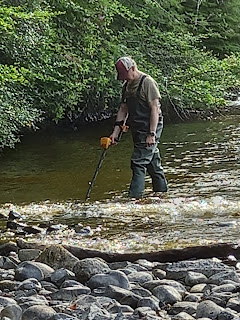
The other area of investigation this year was the location of the famous 1934 Surgeon's Photograph. I take the view it is a fake, but where from? In my article, I hesitated an educated guess that clues in the story and picture suggest it may have been taken at a quiet spot in Foyers Bay. That opened a slight possibility that something of the model may still be recoverable under ideal circumstances. To that end, I headed there in July with my metal detector. You can see me in action below trawling the shallows.


The trouble was I picked up so much metal thrown in over the decades, any trace of the Christian Spurling submarine may be lost in the noise - if there at all! It was a speculative punt and a bit of fun to boot. At the loch in general, I published two trip reports which are here and here. I also did a couple of interviews for crypto-oriented podcasts and you can see what else I wrote by clicking through the 2021 article history to the bottom right of the blog. The other event of note was an unwanted one in the death of water cryptid researcher, Scott Mardis, who died too young this year and all I can say again is rest in peace, mate. You will be missed.

In summary, I wrote 34 articles this year which is actually an all time low of one every 11 days. The best was 104 posts in 2012 or twice every week. You may well ask if I am getting bored with the subject or am finding less to write about. Well, I am actually concentrating more on other subjects non-Nessie related which has had an effect. But there is a bit of truth in the less to write about category. As I enter the thirteen year of this blog and 787 articles on, the majority of the major photos, films, sightings and hoaxes have been covered.

But some have been revisited this year, as mentioned above for the Surgeon's Photograph and also the AAA sighting by John McLean from 1938 as new information bolstered that account. In fact, I hope to start 2022 with an article on one of the classic sightings yet to be covered here. New sightings will obviously continue to come in and personal research will continue as it looks into things old and new.

With that I will wish all readers  prosperous 2022.


The author can be contacted at lochnesskelpie@gmail.com


Saturday, 28 December 2013

Nessie Review of 2013

The year two thousand and thirteen draws to a close and it is time to look back and reflect on what has happened in terms of the Loch Ness Monster and events elsewhere which have an eye towards Loch Ness.

ANNIVERSARY

The most important event this year was the year itself as 2013 marked the 80th anniversary of the Loch Ness Monster phenomenon. Though legends and stories of strange creatures go back a lot further than 1933, this was the year that this now worldwide story was birthed and there is no sign of the old girl dying off yet. Not by a long chalk.

Mention Loch Ness to citizens across the world and the first thing they think of is Nessie. The two are inseparable and long may it continue. The Tourist agencies of Scotland may try to disassociate them and point to the other attractions of Loch Ness, but I suggest they cease and desist.

The story started with the sighting of a water disturbance and two humps seen by the Mackays around April 1933. I took a fresh look at this seminal story some months back. The exact date is not clear but the publishing of their story by the Inverness Courier on May 2nd 1933 can be regarded as the date of importance as far as public awareness is concerned.


To mark the event, a special symposium was arranged by Charles Paxton and Gordon Rutter and was held at the Counting House in Edinburgh in April. The event received publicity worldwide and was well attended as various speakers (including myself) held forth on various aspects of the phenomenon.


It was perhaps a sign of the times that the event was more sceptically leaning than the last symposium in 1987, but a show of hands in response to the simple question "Do you believe in the Loch Ness Monster?" was pretty much 50-50. I gave my own thoughts on the event here.

A week later, a special event to mark the Mackay sighting was held at Loch Ness itself and near the spot where Aldie Mackay spotted the double hump coursing its way across the loch. The event was suitably backed up by Birthday Cake and Whisky.

THE MONSTER

But what of the old beast herself this year past? Though there were things to discuss, sightings again were thin on the ground compared to previous years. By thin, I mean they were not reported in the general media as the number of people who believe they have seen something outnumbers those which make it into print. These days, I suspect you will need a video or photograph of some interest to make it into the public view. However, what turned up this year makes me dub this year, the Year of the Wave Like Nessie.

Firstly, the only sighting I am aware of is one I have not written about until now! It appeared on the Facebook page of the cruise company, Cruise Loch Ness. It goes like this: 

Three different people came to the Wheelhouse today to tell me that they had seen something in the Loch on the 2 o clock cruise. They all described a long black thing on the surface behind the 'Royal Scot' it was visible for a few seconds before disappearing. I wish they'd said something when they were watching it, as I was busy looking where we were going and missed it !! 
This happened on April 5th just the day before the aforementioned Edinburgh Symposium. The skipper, Marcus Atkinson, gave me further details:
I was skippering the Royal Scot when this happened, and it was me that posted on Facebook. It is unusual because, over the last few years no-one has ever mentioned seeing anything, then on one trip three different people from different parts of the boat came to the wheelhouse and mentioned seeing something? I remember that it was a flat day with no wind, and everyone pointed to the same spot on the loch.

At the time I didn't think much about it because - they were all pointing to the place on the Loch where the Royal Scot turns around. This off the horseshoe scree and on a windless day the wake from our voyage up will slowly move across the Loch, at times it does look like several humps moving across the water. Because I didn't see it, it's hard to say anything really. Other than I wish someone had pointed it out at the time!

One may suspect it was just a wave if it was not for the independent tourists who came to Marcus. Was it a Nessie-like Wave or a Wave-like Nessie putting in an appearance for it's 80th?

The wave theme continued with a video taken by David Elder in August when he spotted something snake like making its way across the loch near Fort Augustus. This one generated quite a few comments about waves being caused by long gone boats. A pretty convenient explanation I thought since it does not require any proving on the part of the sceptic. A look at the still below shows three distant white boats near the horizon which makes them over nine miles away based on a height above sea level of 62 feet. There are also some boats in another picture on the far south shore making their way towards the observer.


A bit too far away to leave much of a wave for my liking. Accepting the presence of large creatures in Loch Ness as I do, it is inevitable from my point of view that these creatures can put on wave-like appearances. Admittedly, not good enough for the sceptically minded, but one that I take into account.

The wave theme appeared one more time in November with Jonathan Bright's unusual photograph of something appearing behind a Jacobite cruise ship. This might well be the first infra-red picture of the Loch Ness Monster. Again, the wave explanation was offered and was critiqued on this website. It clearly generated a lot of interest as it currently stands as the seventh most accessed article on this blog.

Oh well, perhaps these three Nessie stories was her just giving us a "wave" on her birthday. Jonathan's photograph is an example of how stories can filter through from recent years. Not everything that makes the news need happen in the year of reporting it.

This was also the year that George Edwards came clean on his hump photograph. Thanks to a conversation Steve Feltham had, the fibreglass prop that was actually photographed was presented to the world. Though George confessed, he was not explicit on how the photograph came about.


THE MONEY MONSTER

That little episode brought into relief a conflict of sorts that rumbled through 2013. I speak not of so called "believers" or "non-believers" in Nessie but a conflict between Loch Ness businessmen and Loch Ness businessmen. Whether they believe there is a large monster in Loch Ness (and I doubt it), they certainly profit from it and where there is money to be made, there is potential for conflict.

George Edwards' stunt brought to light a war of words between such people as to how the Loch Ness Monster should be presented to the public. George's "end justifies the means" approach did not sit well with Tony Harmsworth who preferred the scientific approach. When the Drumnadrochit Chamber of Commerce told Tony to remove negative comments about Edwards from their website, he tendered his resignation.

The wars continued later in the Summer when the two competing exhibition centres at Drumnadrochit got into a tiff over what signs should be shown where. This resulted in one sign being taken and the owner of the Nessieland exhibition being arrested by the police over its theft!


BOOKS

In the world of print, three titles of contrasting nature came out in 2013. The best for me was the biography of famous monster hunter, Tim Dinsdale, titled "The Man Who Hunted Nessie". This was written by his youngest son, Angus. I reviewed this book here. The second book by J.F. Derry called "Loch Ness Monster and other Unexplained Mysteries" was more an anthology of photographs and stories as published by the British newspaper, the Daily Mirror.

In distinction to these was the sceptical tome "Abominable Science" written by Daniel Loxton and Donald Prothero. I reviewed their chapter on the Loch Ness Monster or perhaps the better term is panned it. I gave it one star on amazon.com while nearly everyone else was praising it to the skies and the sceptics never forgave me for that! In fact, they focused on that more on than what I said because I was told the rating should be based on the whole book. Well, I have nearly finished the book and I may up it to two stars. But the fact that they complained more about that the exposure of  poor research suggested deflection tactics to me.


REST IN PEACE

This was the year we also said farewell to some people involved in the hunt for the Loch Ness Monster. The most prominent was the now legendary monster hunter, Professor Roy Mackal, who died of heart failure at the age of 88 in September. Roy joined the Loch Ness Phenomenon Investigation Bureau in 1965 and helped put the "Scientific" into "Investigation". You can read tributes to him by Loren Coleman (who broke the sad news), the Chicago Sun Times, Dick Raynor (who worked with him) and myself.


We also say "Rest In Peace" to Ken Wallis who died at the grand old age of 97. He famously employed his one man autogyro to help the Loch Ness Investigation Bureau perform any airborne surveys of Loch Ness - in case Nessie popped up to the surface. The Loch Ness Monster has been spotted from the air on at least one occassion, so the idea had merit. Doubtless, Mackal and Wallis would have met back then in 1970.


THE INVESTIGATION CONTINUES

Meanwhile, the search for the Loch Ness Monster continued in 2013. Aside from the myriads of tourists that hot summer, people such as myself and Gordon Holmes took the high road to Loch Ness in search of Nessie. I posted recently about Gordon's recent work and my own attempts to glimpse the creature. I always am thinking of a new angle to try and catch that elusive piece of evidence. Of course, there is nothing new there. The aforementioned Loch Ness Investigation Bureau brainstormed many a new technique into existence and some of their ideas are still employed today. The one I don't particularly fancy is "nightdrifting" where you drift around in a small boat in the darkest hours ... waiting for something. I would probably freeze to death first.

Back home, discoveries of a different kind were made as old stories came to light after decades of hiding and well known stories were re-examined. The well kent Jennifer Bruce photograph was shown to be more than just a passing seagull and I finished off my series on the Lachlan Stuart photograph. An old tale from the 1880s telling of a diver's encounter with a strange beast was found as was a curious photograph from 1938 which was closely correlated to a known sighting from the time. A recently obtained zoom in does not reveal much more but indicates some water disturbance to the left. In some ways, it is reminiscent of Gordon Holmes' 2007 video.


What will 2014 hold? God willing, I hope to be back at Loch Ness in April. I also plan to give a talk on recent events at Loch Ness in Edinburgh in March. That year will also mark the 80th anniversary of the most famous Nessie image of all, the Surgeon's Photograph, in April. So expect some media coverage around that time.

And again, we await that story or picture which continues to make the Loch Ness Monster a subject that is more than just interesting - it's an intriguing and enduring story.

A good New Year to you all when it comes.