Sunday, 14 August 2016

The H. L. Cockrell Photograph


And so we come to the final of the "classic" photographs of the Loch Ness Monster. By this I mean those black and white pictures which were the mainstay of Nessie books from 1934 right up to the end of the manic 70s and beyond. It began with the Hugh Gray photo of December 1933 and ended with the Peter O' Connor photo of May 1960. Colour photography came in but, strangely, the dramatic surface images dried up for 17 years despite the heightened attention from the good, the bad and the ugly (I exclude serial hoaxer Frank Searle from this observation).

These have been argued over and analysed with a fine toothcomb as believers and sceptics alike look for evidence to justify their stance on each photo. Eighty three years on, the claims of fraud, misidentification or genuine continue to this day. Six years on, this blog finally gets round to the final one - the H. L. Cockrell picture.

The time is also ripe to write this article for another reason - establishing contact with Herman Cockrell's son, Peter. A bit of detective work, sending off some letters and eventually Peter touched base some months back. Peter was a teenager at the time his father prepared for his Loch Ness expedition and he recalls helping with the equipment, the kayak and his father's enthusiasm and enjoyment for the whole project.

I am very glad to make his acquaintance and obtain material from him that helps form a fuller picture of his father and that expedition he made to the loch over 50 years ago. There is enough material for several articles, but first we focus on the main event.


THE MAN

Herman Louis Cockrell (or "Gus" to his friends) at that time ran a salmon fish farm near Dumfries in the South of Scotland. But before that, he led a self sufficient life on a farm supplemented by his interests in gun punting, a venture that combined shooting wild fowl with a large bore gun on a punt, which was a flat bottomed boat with a square bow adapted to carrying the rather large punt gun used in commercial operations.

Shooting wildfowl provided an unpredictable income and food in a time of post-war rationing and austerity. But Herman was a man who loved adventure on the water and this led to his passion for building his own boats which is most clearly shown in the photo below of his workshop. In fact, the work in progress you see was the kayak for his Loch Ness expedition.


Reading his articles conveys a sense that his knowledge of aquatic animals overlapped into his speculations concerning the Loch Ness Monster. For example, Herman Cockrell thought that the creatures took to land not primarily for food, reproduction or anything territorial, but rather to rid themselves of parasites. I find that an interesting take on this particular aspect of Loch Ness lore.

Combining this with his natural ability to be inventive and come up with solutions led to the pursuit of his other interest in the Loch Ness Monster. Today, people such as myself just order what is required online. The task of the monster hunter today is pretty much off the shelf, multi-feature electronics. Back in 1958, what Herman Cockrell lacked in products was made up for in practical ingenuity. The picture below shows Herman with the improvised camera he was developing for his one man kayak search.


In the words of his son, Peter: 

This began partly as a publicity stunt for the Solway Fishery and partly “…just for the hell of it” but as time passed it became much more serious and he put a great deal of mental and physical effort into the project over a number of years.  It appealed very strongly to his curiosity, his sense of adventure and, very definitely, his sense of humour. His idea, very carefully thought out and executed, was to patrol the loch on calm nights when any disturbance would be more visible on the surface and when, possibly, Nessie would surface more readily.  This required a special craft, good photographic equipment and a means of verifying results and of publicising his efforts whether or not he caught up with the monster! 

This was achieved as follows. An Eskimo kayak was built to give speed, manoeuvrability and stealth on the water at night.  The boat had steel frames to withstand a close encounter with a possibly angry monster.  A well-known photographic company supplied two high quality cameras which Gus built into a waterproof case with multiple flash guns and wiring inside the boat. And finally “The Weekly Scotsman” provided coverage and the use of their photographic labs to develop sealed film capsules to counter any charge of faking photographs. 

The construction of the camera housing exemplified the hands on approach to this whole affair.

In brief it was constructed from a paint tin with a platform for the camera inside and a glass porthole soldered on the front.  A spotlight on top, made from a cinema usherette’s torch, served as a view and rangefinder.  The switchgear was held in a tobacco tin on the side filled with glue to exclude water.  An expanding and waterproof rubber tube operated the shutter and film winder.  There were two flash bulbs on the top in aluminium shaving soap containers plus two more on the bow of the kayak mounted under cocktail glasses to protect them.  It all worked well under test and then in action on Loch Ness.

Leaving nothing to chance, Herman conducted night time experiments with his setup, as shown below. The equipment was ready, the game was afoot, it was time to head north.


However, as publicity for the expedition increased, the mention of explosives was made, and a degree of concern arose amongst parliamentarians which led to a question being made to the Secretary of State for Scotland, John Maclay, on the 25th March 1958:

Mr. Hector Hughes asked the Secretary of State for Scotland if he is aware that Mr. H. L. Cockrell, of the Fish Hatchery, New Abbey, Dumfries, intends to explore the depths of Loch Ness using a knife and explosives; and what steps he proposes to take to protect the amenities of Loch Ness and the fish in it.

Mr. Maclay: I have seen Press reports of Mr. Cockrell's intentions. The use of explosives might constitute an infringement of the Salmon and Freshwater Fisheries Protection (Scotland) Act, 1951, and other statutes, but I feel that this possibility can safely be left to the appropriate authorities.

We can safely say that a bit of exaggeration cropped up in this entire mini-episode. As an aside, when Peter O' Connor made references about bren guns mounted on canoes a year later; you can be sure this was merely a humorous play on what the media had got wrong concerning Herman Cockrell!


THE MONSTER

Moving onto the nitty-gritty of the story behind this picture and what better place to get it from than Herman Cockrell himself? As it turns out, Mr. Cockrell had been invited by The Scotsman newspaper to write a series of articles on his upcoming expedition to hunt for the Loch Ness Monster. That series ran from March to October 1958, culminating in the account of his famous photograph. I reproduce the relevant section below.


The night was very dark until the moon rose, the water calm with a slight swell, as usual coming from a direction completely unexpected. There was a little traffic on the shore. It was pleasant in open water, but the water was a bit colder after a storm. Just about dawn I had my first real test. A light breeze suddenly dropped and left me on a mirror surface about half way between shores with Invermoriston almost abeam to starboard.

Something appeared - or I noticed it for the first time - about 50 yards away on my port bow. It seemed to be swimming very steadily and converging on me. It looked like a very large flat head four or five feet long and wide. About three feet astern of this, I noticed another thin line. All very low in the water just awash.

I was convinced it was the head and back of a very large creature. It looked slightly whiskery and misshapen, I simply could not believe it. I was not a bit amused. With a considerable effort of will I swung in to intercept and to my horror it appeared to sheer towards me with ponderous power. I hesitated. There was no one anywhere near on that great sheet of water to witness a retreat but it was obviously too late to run. Curiously enough I found this a great relief. My heart began to beat normally and my muscles suddenly felt in good trim. I took a shot with my camera in case I got too close for my focus, and went in.

The creature headed slightly away, my morale revived completely. I had another shot and closed in to pass along it as I didn't want to be thrown into the air by a sudden rising hump or two. There was a light squall out of the glen behind Invermoriston, and the object appeared to sink. When the squall cleared I could still see something on the surface. I closed in again cautiously. It remained motionless and I found it was a long stick about an inch thick.

I thankfully assumed it to be my monster and took it aboard as a souvenir. I suddenly felt very tired and stiff and wanted my breakfast. The wind freshened. It can get quite choppy in ten minutes well offshore and I had a hard plug back to my camp in the flat cairn of the north shore. but I felt made. For the last few nights I had rather doubted my metal but I now knew I could do the job if necessary, because I really believed I had found the beast.

I arrived home and I really believed my particular monster was a stick - until the films were developed. The film showed things I had not noticed, either through fatigue of the night or - let's face it - the fright of the dawn. The film showed quite a large affair which had a distinct wash. There was no reason for this wash as the picture also shows the water mirror calm when the snap was taken by the reflection of the hills. What caused the wash? Could it have been Nessie after all? I just don't know.

Another point: the creature was seen by a Mr Brown and his wife from Invergordon next day in the same place but farther inshore. He describes it as "three big black humps churning through the water leaving a foaming trail, with 30 yards ahead of the humps a curious wake on the surface which seemed to be the leading part or head." We have never met and at the time no one knew of my own experience. Perhaps later I shall succeed. Anyway I cannot be accused of mistaking the monster for a stick - but it appears I mistook the stick for the monster.

Overall, the entire series is a fascinating account of one man's pursuit of the monster and the resourcefulness employed in that endeavour. As I read his story, I came to realise that Herman Cockrell was no ordinary monster hunter for in more ways than one he epitomised the spirit and adventure of that genre.

The two pictures Herman took can now be shown for the first time together and both uncropped. The first picture Herman took has never been seen mainly because newspapers tend to pick the best picture and ignore the others. Since Herman took the second photo closer to the creature, it won out. The first and previously unpublished picture is shown first followed by the more familiar shot.


THE REACTION

I will look at these photos in more detail later; but what did he see and how did the various Loch Ness experts react? Naturally, various theories have arisen to explain what was in the second photograph. The first focuses on the stick mentioned in Herman Cockrell's account. Because Herman speculated that he may have mistaken the stick for what he initially took to be the monster, that has been seized upon by sceptics who then summarily dismiss the case. I will address the stick theory in the next section.

Of the main Loch Ness authors, Tim Dinsdale believed the picture was of the Loch Ness Monster (Herman's son sent me correspondence between Tim and his father requesting permission to print the photo in Tim's 1961 book). However, Tim is the only one I found that came out in support of the picture.

Others were non-committal, such as Nicholas Witchell in his "The Loch Ness Story", who says it "may" be one of the animals. Henry Bauer is also a "maybe" in his "The Enigma of Loch Ness". Other pro-Nessie authors make no mention of the photograph at all in their main works, such as Constance Whyte, Peter Costello and Ted Holiday. Whether that makes them pro, anti or neutral is not clear as sometimes I have found comments in minor works by authors which do not make it into their main books. For now, one must assume they are no better than neutral.

Which proved to be somewhat of a disappointment to me, but the stick incident seems to have muddied the waters too much for some. Indeed, if Herman Cockrell was non-committal in his initial public pronouncements, it is no shock that others have followed suit.

Of the critics, I was somewhat surprised that Maurice Burton does not mention the picture in his book, "The Elusive Monster". However, Ronald Binns is unequivocal in declaring it as a tree trunk (and first proposes that you can see through it). Steuart Campbell writes in his book that it looks like a stick, but in the end is not entirely sure what the picture shows. Nessie believer Roy Mackal concurs with the sceptics in his "The Monsters of Loch Ness" in identifying the object as a small log or stick.

A further search revealed that Maurice Burton did propose that Herman Cockrell was witness to his favoured vegetable mat in a 1982 article for the New Scientist. This mechanism causes vegetation to rise to the surface on the buoyancy of a build up of methane and, having discharged, allows this natural construct to sink out of sight. Today, this is a theory that has generally fallen out of favour in sceptical circles due to the eutrophic nature of Loch Ness. My opinion is that, even if true, an inspection of an area of water after the eruption of a vegetable mat would surely leave more than just a thin stick behind.

Going back to log theories, by proposing that a log was behind the photo, Ronald Binns was basically accusing Herman Cockrell of being economical with the truth (because he only reported a puny stick). In response to such log theories, Herman Cockrell wrote back to the Weekly Scotsman on the 6th November 1958 with these words:

The statement by the monk from Fort Augustus speaks of logs, floodwater and foam. But none of these were involved.

These are the main theories, now let us move onto a more thorough analysis of these pictures.


THE STICK

First of all, let us go back to the stick that seems pivotal to various commentators on this incident. Herman  Cockrell described it as a long stick about an inch thick. When I asked his son, Peter, about it, his reply was: 

I do remember seeing the stick at the time because he brought it home.  It didn’t resemble the picture – it had some stubs of branches but was basically quite thin and straight.  I do not have any photos of it unfortunately.  

So let us try and dismiss the theory that the object in the photographs is a stick. I begin with my own experiments with a stick at Loch Ness a while back. The photograph below shows the stick for this simple experiment. It was about three feet long and at least an inch thick.


The procedure was simple. Throw the stick into the loch and take some photographs of it. I leave it to the reader to figure out where the stick is in the photograph. It was no more than 10 metres from me.


Just in case a black and white photograph may enhance the appearance of the stick, I include such a version below. Admittedly, the light levels would have been lower for Herman Cockrell, but I see that as a stronger argument that the object in the photos is not a stick. For your information, the stick is just left and above of the centre of the picture.


In fact, I would have been at a more elevated position than Herman would have been in his canoe. Again, that would make the stick more visible for my pictures than it would for Herman's situation. Based on this experiment, I would conclude the object in the photograph is unlikely to be a branch of four foot length and one inch thick.

One other aspect of the stick theory I would like to address is the idea that the better known version of the Herman Cockrell photo shows a gap in the object, thus suggesting it is indeed a log or stick. This is shown in an enlargement of the object. You can see a lighter region on the left side of the object.


There are three reasons I wish to advance as to why this is not a convincing view. Firstly, the stick, as described by Herman Cockrell and his son, does not sound like a stick that would create a gap. It was long and thin and that, to me, means no possibility of a gap between it and the water.

Secondly, Herman Cockrell himself, suggested that what is seen is no more than a wave briefly hitting the object. I quote again from his letter to the Weekly Scotsman of 6th November 1958 where he briefly speaks of the trouble he had with his photographic setup:

The spotlight for view finding was no use after dawn so I had to improvise by holding the camera up and viewing through a tiny hole under the light case. This may be why I missed the splash that appeared during the taking of the snap.

The third reason can be deduced from the now available first photograph. As you can see below, a zoom in of this picture shows no indication of a gap between object and water. Based on these three arguments, I would suggest the light area is indeed a splash which, by consequence, reinforces the idea that this was an object more substantial than a stick.



Realising that the stick theory was in troubled waters, W. H. Lehn, an electrical engineer from the University of Manitoba, attempted to salvage the theory by proposing that the appearance of the stick had been visually exaggerated by a temperature inversion creating mirage conditions. You can read his 1979 article at this link. Though this theory may have some merit for vertical objects, I was not convinced it did for a low lying, horizontal object showing no more than half an inch above the water (assuming such mirage conditions actually prevailed at the time).

By way of example, Lehn demonstrates the mirage effect on a near vertical stick on Lake Manitoba where the temperature layer difference was at a maximum of 25 degrees centigrade (way above Herman Cockrell's environmental conditions). Viewed at a distance of 10km, the stick can be seen at one point to vertically distend to double in apparent height. A doubling of half an inch of stick is hardly going to constitute much on any photograph.

However, Herman Cockrell only had about 20m of potential temperature inversion to look through compared to the much more distortive effects of 10km of such atmosphere. Moreover, an examination of the better known photograph shows no evidence of a mirage. There is no indication of the surrounding waters being distorted or the distant shoreline.

In concluding this section, perhaps a comment from Herman Cockrell's account may explain the role of the stick in the whole affair:

It looked like a very large flat head four or five feet long and wide. About three feet astern of this, I noticed another thin line. All very low in the water just awash.

May I suggest that the "thin line" seen was the stick. I can't prove that, but if it was in close proximity to the creature, it would have registered a small visual presence.


 FURTHER ANALYSIS

That the picture was taken at the location specified is in no doubt as this image from Google Street View shows. The hill contours from left to right match those in the second photograph taken. Mind you, no one was seriously doubting that Herman Cockrell was where he claimed to be.


Now having both photographs available for analysis allows new information to be extracted. The main question is whether the object in question moved of its own accord? By examining the shorelines in the two pictures, correlation points can be identified. Two such points are circled on the two pictures below.


As you can see, the object has moved in relative terms from the right of the two reference points to the left of them. But the difference between the two pictures is the combination of both the movement of the object and the kayak. The movements between the two shots are described thus by Herman Cockrell:

I took a shot with my camera in case I got too close for my focus, and went in. The creature headed slightly away, my morale revived completely. I had another shot ...


Merging the two photos over the two reference points give us the following composite showing the relative motion of the creature. Note Herman's reference to the object as a "creature" in this quote and herein lies his ambiguity. A stick may move along with the prevailing south western wind up the loch, but Herman's language does not suggest an object driven by external forces. The phrases "it appeared to sheer towards me with ponderous power" and "the creature headed slightly away" suggest Herman witnessed a degree of self propulsion in the object under view.


Critics may take it as read that Herman Cockrell stated he merely saw a stick, but his ambiguous language, such as referring to the object as the "creature" suggests otherwise. In fact, given what I have said about his experience on various waters, Herman Cockrell strikes me as a man well equipped to judge the movement of objects on water. He had spent many a time on his own home waters in pursuit of his punt canoe and even describes himself as a "sailor" to Tim Dinsdale in one of their correspondences.

My own judgement is that the relative positions of the object in the composite suggests a motion not accounted for solely by wind or Herman's cautious approach to the object. That would suggest an object possessing a degree of inner motion.

The object itself presents what is a mainly uniform dome shape in the tradition of the single hump sighting. If the width of the object is the maximum of five feet stated by Herman, then the maximum height is about 10 inches out of the water. Is this symmetry evidence of a living object? I would say so, certainly it is not consistent with the shape of tree debris.

What is perhaps of equal interest is the whiteness surrounding the object. This is contrasted with the darker tones of the hills being reflected on the surface of the water. This is most likely an area of water disturbance around the object. It is evident around the object in both photographs which suggests it is a phenomenon associated with and generated by the object.

The extent of the disturbance is not as symmetric as the object itself as the disturbance extends an apparent distance of about 7.5 feet to the left of the object and about 10 feet to the other side. My own interpretation is that this is in fact the bow wave of the object generally moving in the direction of Herman Cockrell. If the creature is heading towards you at near water level, then the disturbance caused by forward motion will look a horizontal line of turbulence.

That this situation is intimated by Herman himself is again exemplified by the phrases, "swimming very steadily and converging on me" and "it appeared to sheer towards me with ponderous power". Furthermore, the phrase "the creature headed slightly away" before he took the second photograph would also imply that the furthest arm of the bow wave would undergo a degree of foreshortening in the picture, and this is what we get with the left arm being 25% shorter than the right arm. The first photo, though more indistinct in showing the wake, suggests more equal bow arms.

Finally, there is a suggestion of another object about 10 feet to the right of the main object in the picture. It is somewhat spherical and has a maximum extent of 8 inches. It is visible in the second, well known picture, but is not visible in the first picture. What this might be would be a matter of speculation on anyone's part. Is it physically connected to the main object under the surface or is it completely unrelated?

For me, there is just not enough information to favour one explanation above another. However, I would say that if the object is heading towards Herman Cockrell, then the object on the right is not likely to be the head.


CONCLUSIONS

In between planning and plotting his trip to Loch Ness, Herman Cockrell imagined what he might encounter in doodles such as the one below. But what did he really encounter in 1958? Did fatigue and exertion really make him mistake a thin stick for what is portrayed in the two photographs? I do not think so, the evidence of his testimony and a more detailed examination of the pictures points to something larger and moving under its own power.


That is enough to satisfy me that what we have here is a genuine encounter with one of the monsters of Loch Ness. Using a rule of thumb that one third of the object is exposed above water, gives us a minimum size of this creature of fifteen feet.


The author can be contacted at lochnesskelpie@gmail.com

Sunday, 7 August 2016

A Review of Darren Naish's "Hunting Monsters"


It appears that the latter end of this year will have more than its fair share of book reviews as several books on the Loch Ness Monster make their way to the publishers. In that light, I thought I would get one review out of the way that has lain in the form of written notes for some months now.

I refer to Darren Naish's "Hunting Monsters: Cryptozoology and the Reality Behind the Myths" which was published in Kindle format back in January this year. As you can guess from the title, the mode is very much debunking the "myth" and presenting the sceptical view of "reality".

Darren's ebook comes after a similar publication from 2012 entitled "Abominable Science!" by Daniel Loxton and Donald Prothero. That book was praised to the skies by the sceptics but when a closer look was taken by those who did not have a vested interest in the book, things began to fall apart. My review of that book can be found here.

Is this book any better? I would say it is, though the presented "reality" against the "myth" of the Loch Ness Monster is again far from conclusive. Compared to "Abominable Science!", there is more attempts to be original in the thinking behind sceptical interpretations of Nessie cases. However, it has to be said, that a lot of that thinking seemed to originate from sources other than Darren. 

The book begins with an assertion that the diversity of creatures described points more to human imagination than actual animals awaiting discovery. The book seems to present us with an either/or choice here, but it is not as simple as that. My alternative opinion is that differences in monsters described is down to various factors.

Firstly, witnesses do not always get the details right. Even though they may have seen something large and alive, the finer the detail described, the greater the room for error. This is especially so at greater distances and other conditions which disturb a clear view. Also, it is clear that some of the 1800 or so accounts will be tall tales. If you have someone fabricating their account, then they could describe almost anything that muddies the waters and corrupts the database. 

Roy Mackal, in his book, "The Monsters of Loch Ness", took the position that 90% of all sightings were fake or misinterpretation. I do not personally think the percentage is that high, but if it was that close, it is no surprise that non-monster accounts contribute to an unclear picture.

Again, the King Kong film is raised as an influence. I covered this in my review of "Abominable Science!". Suffice to say it is not a convincing theory. Some mistakes began to surface as I read through the book. For example, in "showing how things were afoot at the loch at the time" before the famous Spicer report, Darren mentions the 1932 Fordyce land sighting. However, that story was not made public until 1990 and had nothing to do with the mood "at the time".

The aforementioned Spicer story is examined and I wish to point out an example of exaggerated narrative from Darren. Of this sighting he says:

Over the years, the description became increasingly sensational. It started out as 2– 2.5 m in length but gradually increased to 9m.

Unfortunately, this is the kind of subliminal language that implants the wrong kind of impression into the mind of the reader. Darren appears to be trying to demonstrate that monster stories grow with the telling. However, he is completely wrong. The first account from the 4th August 1933 does indeed state the size of the creature as being 6 to 8 feet. However, the "gradual" part is not true.

The truth rather lies in Rupert T. Gould's book, "The Loch Ness Monster and Others", published about 10 months after the Spicer event. Gould quotes a letter to him from George Spicer which states:

After having ascertained the width of the road, and giving the matter mature thought in every way, I afterwards came to the conclusion that the creature I saw must have been at least 25 feet in length.

It's as simple as that. George Spicer re-evaluated based on the width of the "ruler" the monster had been seen crossing over - the road. Why Darren Naish omitted this detail is not clear. After all, he quotes Gould in regard to this case. In the context of such inaccuracies, I noticed one withering reviewer of this book on Amazon declare this:

"Anyone who actually believes in the Loch Ness monster ... should read this - it would help them to grow up.

Now I don't know if this reviewer could even find Loch Ness on a map, but one gets the impression that such reviewers have a picture of "believers" running to their caves in fear of such cutting sceptical books exposing their so-called psychological deficiencies. The truth is that a lot of these reviewers know little about Loch Ness and its Monster and assume these like-minded authors speak with unerring accuracy on Loch Ness matters. They don't. Period.

Whereas Loxton and Prothero seemed to not go beyond 1994 in sceptical Nessie thinking, Darren presents more modern interpretations - such as the famous Hugh Gray and Peter O'Connor photographs. He suggests Hugh Gray photographed a swan and Peter O'Connor used his canoe to fake the well known hump picture. 

Well, I looked at the Gray and O'Connor theories and put a bullet through them here and here. Advocates of a large, exotic species in Loch Ness need have no fear of such theorising by sceptics. In fact, I enjoy dismantling their weak theories and this book was no exception.

Now I mentioned that Darren was not the actual source of these swan and canoe theories. That honour goes to long time Nessie sceptic, Dick Raynor. How much of Darren's treatise on the Loch Ness Monster is actually his own or others such as Dick Raynor is hard to ascertain, but these easily challenged theories were known to me well before Darren's book.

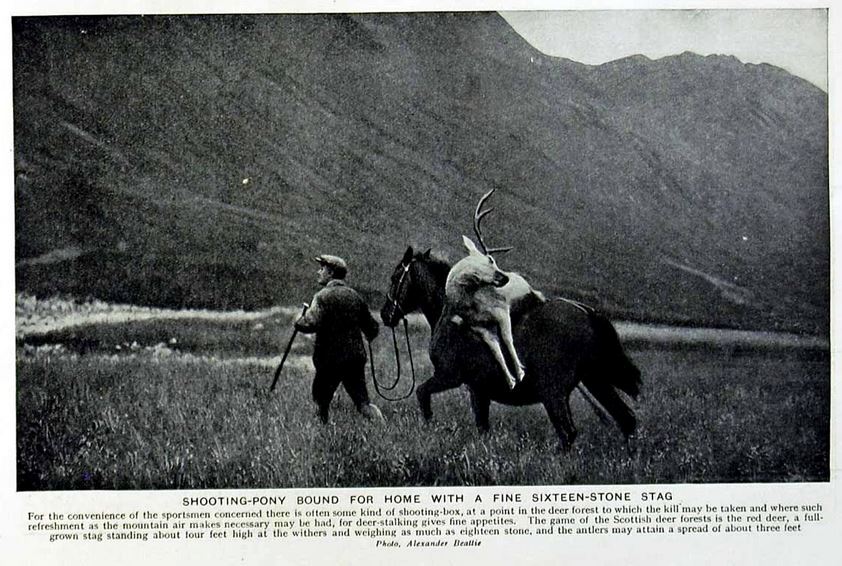
Another place where Naish relies on Raynor is the aforementioned Fordyce land sighting. We are told that, in fact, what Mr. Fordyce saw that day was a donkey carrying a dead deer bagged by some hunting party. Here is a picture of a horse carrying a bagged stag compared to the animal that Lt. Cmd. Fordyce claimed to have seen.


Yes, I can see what they are driving at here ... not. Some of the interpretations of the sceptic baffle me. I admit the Fordyce creature is strange - even by Loch Ness Monster standards. But, even allowing for memory lapses on the part of Fordyce, nobody should accept such a weak explanation. Better to say nothing and take a neutral position.

I could go on with the problems with this Nessie section of Darren's book. His handling of the folklore of the Loch Ness Water Horse is unsatisfactory. You can read my introduction to this theme here. His dismissal of pre-1933 accounts is, of course, vital to the framework of the sceptical theory since it relies on Nessie being a creation of the Great Depression years.

Moreover, his description of Richard Franck's 17th century "floating island" at Loch Ness, as a man-made raft runs completely counter to what even Franck theorised about this strange object from 1658.

A thought did cross my mind as to whether Dick was grooming Darren as his successor. After all, Dick is now moving into his late sixties, as is Adrian Shine. Despite our best intentions, old age will eventually put a stop to any argument or debate one may wish to engage in and the question of succession seems to be a serious question for Loch Ness sceptics.

As I survey the online and published domains, I see no clear and worthy successors. Perhaps Darren is seen as "The One", but in my view, once Dick and Adrian get out their slippers and pipe, Loch Ness scepticism will go down the plug hole.


The author can be contacted at lochnesskelpie@gmail.com


Monday, 1 August 2016

Karl Shuker's Book on Nessie

It seems I am going to busy for the next few weeks. No sooner have I just publicised Malcolm Robinson's book, "The Monsters of Loch Ness", than Karl Shuker's book, "Here's Nessie!" is about to be published too! Here is the front and back covers for your enticement.

You wait ages for one Nessie book and all of a sudden two turn up!


Malcolm Robinson's Nessie Book Now Published


Malcolm Robinson's "The Monsters of Loch Ness" is now out and he has put out his own details below. I have already bought the Kindle edition for ease of searching but will also buy the paperback for the library shelves (do people do hardback now)? I will review in due course.


MALCOLM ROBINSON NEW BOOK ANNOUNCEMENT

The Monsters of Loch Ness (The History and the Mystery) is NOW available to buy and download. I’m very proud of this book folks, it’s been in the offering since I was at least 15 and now it’s finally seen the light of day. 

THE MONSTERS OF LOCH NESS (The History and the Mystery)

OK folks I’m pleased to say that I can now give you information on how to obtain a copy of my new book, The Monsters of Loch Ness, (The History and the Mystery) You have three options.


OPTION 1: LULU. Order it direct from Lulu (not the singer, the company) Just type in either my name in the search bar or type in The Monsters of Loch Ness (The History and the Mystery) Upon doing so the booking form will come up. www.lulu.com
 
OPTION 2: AMAZON. No matter where you are in the world if you are from France, Belgium, Italy U.K. or the Netherlands, go to the Amazon of your country and again type in the search bar The Monsters of Loch Ness (The History and the Mystery) Upon doing so you can place your order. www.amazon.co.uk Please note that for the moment that the paperback version of the book is not at the moment up on Amazon (but it will be very soon, I’ll keep you posted when it’s up)

OPTION 3: KINDLE. My book is also available in those dam blasted kindle thingys. (I’m not a fan of Kindle as you will see) I’m from the old school you can’t beat holding a good old book in your hands a Kindle for me doesn’t give you the same feel. But hey ho, for some that’s their bag. So should you want a Kindle version and only get an 80% feel of what my book is all about, then again go to the Amazon of your country and type in the search bar The Monsters of Loch Ness (The History and the Mystery) www.amazon.co.uk Download at £1.99 (Remember, I can’t sign a Kindle !)

THE PRICE.
The retail price for my 590 page paperback book with 73 photographs is £15:99. For Kindle it’s around £1:99 per download (I believe)


GETTING IT SIGNED.
OK boys and girls some of you have asked me to sign you a copy of my new book The Monsters of Loch Ness (The History and the Mystery) If you were to order direct from the publisher then of course it wouldn’t be signed. The only way to do this is for you to pay me, I’ll order the book at this end, sign it for you, and send it straight off to you. Job done.

So if you want a signed copy, here is what to do;
1) Send a cheque made payable to Malcolm Robinson for £18:00 (this includes the postage for me to send the book to you. (*)
2) Send your cheque and who you would like the book signed to (if it’s not you let me know who to sign it to) and send to. Malcolm Robinson (Books) Flat 5, Unicorn House, Croft Road, Hastings, East Sussex, England, TN34 3HE.
3) (*) The book’s retail price is £15:99
It’s as simple as that over to you. E-mail me at malckyspi@yahoo.com if you want a signed copy.


CLASSIFICATION: Non-Fiction
FORMAT: Paperback
PUBLICATION DATE: August 2016
ISBN NUMBER: 978-1-326-72942-4
PRICE: £15:99
PAGES: 590
PHOTOGRAPHS: 73

Wednesday, 27 July 2016

9206 Pictures and Counting

I am currently relaxing on holiday on the fair Isle of Lewis and now have time to get through a prodigious task - getting through the 13,400 or so pictures recorded on one of my trap cameras left at the loch over a sizable number of months until this May.

It is a mind numbing labour, I have to say, pounding the left arrow key to proceed to the next picture which pretty much looks like the previous one. These cameras were designed to take away some of the monotony of sitting by the loch staring at it for hours waiting for the monster to break surface. The problem with this particular make and model is the picture below. 


Whenever the sun set in a clear sky across the loch, it triggered hundreds of pointless pictures. The solution is pretty clear, just point the camera further north and avoid these glares. Mind you, the pictures are not so pointless if the creature accidentally appears in such a picture. So far, that has not occurred. Some pictures of interest do appear from time to time as now illustrated below.

Here's some people out on a boat. It looks like they are preparing some fishing rods. A good sized hump would occupy much of the same length to give you an idea of scale.


The approach of night gives the loch a darker hue of blue in this picture.


Within ten minutes, the camera switches to infra red and it is into black and white mode.


Here is the moon over Loch Ness.


Now what do you think this night shot shows? I do believe this kind of picture has been associated with UFO phenomenon, but I think it is more likely to be an insect travelling more rapidly than the shutter speed of the camera. Well, something like that!


The next picture is a definite life form, but what I don't know!


These two creatures are most assuredly known to me....


This picture made me wonder if there was a fire in progress on the opposite hills.


So, about 4000 more pictures to check. With some tweaking for the autumn and winter months, I will hope to obtain only pictures of actual animate, nearby objects. The hunt continues!

The author can be contacted at lochnesskelpie@gmail.com

Wednesday, 20 July 2016

Malcolm Robinson's The Monsters of Loch Ness


Malcolm Robinson's book on Nessie will be out soon, so look out for it the usual outlets. Two thoughts struck me. The first was how Malcolm managed to use the same title as an existing Nessie book? I refer to the book by Roy Mackal from 1976. I guess you're allowed to do that sort of thing. With 66 titles on the beast, I guess authors can only juggle the words "loch", "ness" and "monster" so much!


Secondly, I note that Frank Searle's infamous February 1976 Nessie picture features on the cover. I look forward to Malcolm's treatise on Frank Searle and his book in general!


POSTSCRIPT: I note the book is now available at Lulu here.


The author can be contacted at lochnesskelpie@gmail.com


Friday, 15 July 2016

Barry Blount RIP

Loren Coleman has informed the cryptozoological community of the death of Barry Blount at his news website. I had been in correspondence with Barry a few times over his love for the Loch Ness Monster mystery.  By the time he had touched base with me, he was living in the province of British Columbia involved with the various cryptids in that part of the world. Now, if I had to leave Scotland, the beautiful province of British Columbia with its Sasquatch, Cadborosaurus and Ogopogo would be a pretty attractive option. Perhaps I'll get there one day.

Barry told me of an experience he had with Nessie once while pursuing the beast with a friend back in 1964. I published that account on this blog in 2013 and you can read it here. Barry also communicated some ideas to me including a novel one on the Lachlan Stuart photograph. You can read his document on that here.

Once again, rest in peace, Barry.


Tuesday, 12 July 2016

Five Hundred Posts and Counting

As the title says, this is the five hundredth posting I have made to this blog since its inception. Also, if this blog manages to survive another six days to reach the 18th July, that would mark six years of blogging on the Loch Ness Monster.

Now I recall years back when this blog was bright eyed and bushy tailed that somebody of a sceptical persuasion suggested I was wasting my time with such a thing and should employ my talents elsewhere (perhaps being a sceptic?). That advice was declined and I am glad I did it as the website has gone on from strength to strength.

The visits to the blog began slowly enough, but now it enjoys thousands of hits per day with Google ranking it high on a search of "loch ness monster". Sometimes the blog manages to rank as high as third (below), most of the time it is lower down as it competes with the latest Nessie stories from the more popular pages of the mainstream media. But the main thing is that it has a presence that ensures the alternate sceptical view is not dominant.


But, as said before, that is not so much as a matter of boasting but rather the recognition that people find what I do interesting enough to revisit the site on a regular basis. I am happy to oblige them as I find the whole subject of the monster a fascinating business myself, bolstered by the fact that I continue to believe that a real creature of monster proportions inhabits the loch.

And I would say that I increasingly believe that proposition to be true as I have re-examined old monster reports, films, photographs and looked at them from a fresh perspective. Classics such as the Hugh Gray and Peter MacNab pictures have gone up in my estimation as have others.

This also includes reports from sincere and experienced witnesses who bolster the argument despite the withering attempts of sceptics to put down witnesses and portray them as incompetents and liars. I have spoken to some of these people myself and I do not get the impression that they are fools who can't tell a bunch of birds flapping about from a large, dark hump bigger than anything known to be in the loch.

The strap line at the top of the blog to reclaim the monster from the current tide of scepticism has included reviewing past eyewitness testimony as well as critiquing not so convincing sceptical theories. Those arguments are laid out elsewhere, but as time has progressed, I have increasingly seen their ideas as hollower and hollower.

If the idea of a colony of aquatic dinosaurs can be seen as naive, then the idea of boat wakes, birds and logs solving the mystery is simplistic to say the least. The solution lies in between and as you can see in the picture below, there is no lack of candidates! Each theory has its shortcomings and therefore the search continues.


This has led to conflict, especially when the comments section of the blog was left open to all and sundry. That left the door open to sceptics who, when they lacked a rational argument, resorted to ad hominems. Admittedly, those on the other side of the debate were not averse to the same approach, so now that part of the blog is tightened.

You still get the odd nutter sending glib and insulting comments. They even pose as believers and say solemnly that my own arguments have convinced them there is no Loch Ness Monster! These get binned and never see the light of day.

One sceptic even said that restricting comments would send web traffic down so much the blog would die. Since that comment was made, web traffic has doubled. The problem with sceptics was that they valued their comments higher than the content they were trying to discredit. Sorry guys, we're here for the Monster, not you.

Of course, the blog is not all about sightings. We have discussed theories, folklore, cultural and media representations, the people and personalities behind the whole mystery, book reviews, upcoming events, my own trips to the loch and other mysterious beasties from around the world. It's all there and if it isn't, I hope to include it in the future!

As ever, there is a backlog of subjects to address, investigate and write up. This is a subject that just keeps on giving as new reports and photos roll in, old material comes to light or a new angle is found on an old subject. While other websites grind to a halt, rarely update or just try and present tired, sceptical opinions as objective data, I will aim to continue to provide more material on this centuries old topic.

What is the conclusion of the matter? Someday this blog will have a final entry and I would like to think it would be a welcome message completing the circle on the first post back in 2010 as it introduces the website and directs future enquirers to the various sections.

But when that end is near and faces the final curtain, the record will show that I did it my way and not the sceptics' way!

Thank you for your support.


The author can be contacted at lochnesskelpie@gmail.com


Wednesday, 6 July 2016

A Loch Ness Monster Sighting from 1993

I found this Nessie report while I was doing my usual rounds of the Internet a few weeks back. It is taken from the Highland News dated 28th August 1993. It is a known account and Gary Campbell has the sighting listed on his sightings register site for the August 10th.

Steve Feltham, stationed at Dores Bay, has known Roland O'Brien for 25 years and I asked for his opinion of this report. He certainly regards this as a very good sighting by a local fisherman who has fished on the shore extensively.

And I would agree with him. I have said it before, but I always give more credence to people who have a long track record of watching the loch (for whatever reason). They are the ones who are more than familiar with the moods of the loch and are far less likely to be deceived than someone just off a tourist bus who has never lived near a body of water in their lives.

The original clipping is below with the text of the report further below for ease of reading.


A SCANIPORT man has broken his silence on a rare double sighting of the Loch Ness Monster. He is 41-year-old forestry and landscape contractor Roland O'Brien of Balmore Farm, Scaniport.

The memorable night Nessie gave him an encore was Tuesday August 10 but he said that, like most country folk, he's been reluctant to talk about it. He told the Highland News he was waiting for a fishing mate at the 30mph limit sign on the Foyers side of Dores when he had the biggest shock of his life. 

 "I had baited my rod and had been fishing for 10 minutes. and there were quite a few fish rising," he said.

"Something caught the corner of my eye, but I didn't pay it too much attention to start with. It was its strange behaviour that made me look again. I saw a large dark hump about 500 yards out from the shore and heading toward the buoy in Dores Bay. From the size of the buoy, I would estimate that what I saw was between eight and 10 feet long." Roland revealed.

"It was about four feet out of the water at its highest point, making it larger than the buoy. It moved rapidly for about five minutes and seemed to be making lots of splashing in front of it. It came to a stop, then started again. It stopped again, then started off again a third time." Roland said.

"About 50 metres from the buoy it stopped. appeared to turn round, then headed back. Then it sank on the spot without a trace." Roland said he did not know what to do, because he was simply shocked rigid by his experience. But he was to receive a second helping! 

I'd been watching for about four minutes before the creature went down," he said. "then, about a minute later, up she came again! The second time, there was no great commotion. It was moving reasonably slowly back towards me in about a 60-degree angle. The shape was the same as before. It looked fairly bulky.

Swimming back from the buoy, it came to about 350 yards from me. I watched it again for about five minutes. About halfway into the second sighting, there was a big splash beside the hump," Roland said. "The splashing continued for a couple of minutes, then it sank again, and again it left no trace."

Again he was not frightened, just shocked rigid, not knowing what to do. Altogether, he had had a grandstand view of Nessie for something like 10 minutes in excellent visibility with the loch calm.

"I have been watching Loch Ness for something like 10 years," Roland said, "I had seen something twice before, but never anything like this. Any talk of logs, dogs, cattle or deer swimming is nonsense. What I saw was large and capable of going from standstill to extremely fast in seconds. Not only that, but when it turned, I seemed to see something light. There seemed to be a lighter underside to the creature."

His main regret is that his fishing mate Kenny MacKenzie, who has had a classic sighting himself, missed Nessie's double show by 10 minutes.

"Mind you" he laughed, "it was even worse for monster hunter Steve Feltham. He was on the wrong side of the loch, at Fort Augustus, at the time!"

So ends the report and consider that statement, "any talk of logs, dogs, cattle or deer swimming is nonsense". I like that. This man is a "knower" and not just a "believer". I don't actually know Mr. O'Brien's view on his sighting 23 years on, but I suspect he hasn't decided on logs, dogs or ungulates.

Or perhaps, as some sceptics like to aver, this is another of those local "jokers" who love to pull our legs and have a laugh behind our backs. I think I will reserve judgement on who is actually joking here.


The author can be contacted at lochnesskelpie@gmail.com


Saturday, 2 July 2016

Revisiting the William Jobes Photograph


Do you remember this picture from back in 2011? It created a bit of a stir back then and made its way into the national newspapers. At the time, I published a couple of blog articles (here and here), but I stated that until I heard from William himself, I couldn't really say more. 

That time came last Saturday as William came up to talk to me at the Scottish UFO and Paranormal Conference in Glasgow. I am glad he did as I now have a much clearer picture of what happened over those days in May 2011 straight from the man who witnessed and photographed the Loch Ness Monster.

Right enough, I am now moving from somewhere between neutral and the theory that this was just a piece of garbage that had floated into the loch. I now take the view that William took a series of photographs of Nessie and that his account was distorted and downgraded by the media  (despite the sceptics telling us that the papers have a habit of "bigging up" Nessie reports). William told me that the tip to the right of the picture is the tail of the creature.


Of course, speaking face to face with a witness makes a difference and I was convinced of his sincerity and genuineness. That may not stop sceptics saying that he genuinely misinterpreted something he saw, but based on what I heard and saw from him, that does not look likely. The thought that struck me was why no one else had come forward with a photograph of this so-called piece of rubbish floating around in the loch? After all, it wasn't going anywhere and there are more than enough tourists around Fort Augustus Pier in late May watching the loch with their cameras.

Anyway, the story is not for me to tell at this point in time. William told me that his story and photographs will be appearing in Malcolm Robinson's soon to be published "The Monsters of Loch Ness". I spoke to Malcolm at the conference on Saturday and it looks like it will be out in about a month. I won't steal his thunder and I will comment further once the book has been published and reviewed here.

The author can be contacted at lochnesskelpie@gmail.com


Wednesday, 29 June 2016

Carcass at Loch Ness

Just saw this on Facebook. The things you find at Loch Ness (I think this is Dores beach). Apparently there is some filming going on there and it looks like someone made a visit to the local abbatoir. As explained in a previous posting, scenarios such as this are not likely due to the loch's topography and chemistry.

The Daily Record catches up with the story here.

Steve Feltham also reports from the scene by video here.

Details about the TV drama series behind this publicity stunt can be found here.


Meanwhile, what is this that has just been photographed at the London Docks? Was it the cause of the previous humps videos? Going by the photos I have seen it looks about three to four foot long.


Sunday, 26 June 2016

Video Lecture: A Paranormal History of The Loch Ness Monster

For your delectation, here is the video of my lecture given 25th June on a paranormal history of Nessie. This was part of the 2016 Scottish UFO and Paranormal Conference. It was a good time as I revisited my old Alma Mater, Glasgow University, where I studied Astronomy, Mathematics and Natural Philosophy under such people as Professor Archie Roy (who was unbeknown to me at the time a leading psychic investigator). This time I came to learn about demons, poltergeists, sasquatch, UFOs and mushrooms.

I decided to give the paranormal view on the Loch Ness Monster by way of a history of such thinking. Given that many attendees may not have been fully familiar with the subject, I also began with a general history of the subject. The Sunday Herald newspaper ran an article on the conference, which you can read here.

The author can be contacted at lochnesskelpie@gmail.com


Tuesday, 21 June 2016

The Corrie Creature


It was a while back that a reader posted a comment on this forum suggesting I look up a sea serpent story he had once read in a book. I eventually did and bought the book he recommended by Michael Prichard entitled "Sporting Angler" published in 1987. The story begins off the Isle of Arran on the west coast of Scotland just off the Bay of Brodick, to which I add an approximate circle on the map below. The story I reproduce verbatim below and the creature sketch above is taken from the same chapter.


I have always been a stickler for trying to make a correct identification of fish that I have caught or seen. This means giving the catch more than just a that I have caught or seen. This means giving the catch more than just a cursory glance. I once asked a well-known sea angler, who was happily  engaged in feathering for mackerel, what colour the species was. I stopped him turning round for a quick peep into the fishbox, and he found the simple task of colour description almost impossible. When I pointed out that he must have caught thousands of that particular fish over the years, he readily agreed that he and probably many other anglers rarely take more than a quick look at their fish.

Sometimes, however, we come across a situation and a rarity that defies adequate explanation; and often the occurrence so varies from the norm that we dismiss it or keep quiet for fear that our sanity will be questioned.  I had an experience, years back, that I have only talked of recently, encouraged by reading of similar experiences by highly regarded writers. I leave it to you, the reader, to make your own decision as to its validity.

I was fishing for haddock, with Mike Shepley, off the Isle of Arran. Our dinghy was drifting on an oily-smooth sea, over 9 fathoms of water, off the Corrie shore, just outside the Bay of Brodick. The evening was beautiful, little cloud cover and a half-light that allowed us to see for miles. Mike and I had caught a few small haddies while we chatted away and enjoyed a simple fishing that was lazy yet productive.  We were suddenly alerted to a noisy splashing ahead of the boat's bow. A glance showed that there was considerable disturbance to the surface about 50 yards farther out in deeper water.

Our immediate thought was of a shoal of mackerel, a breaching basking shark or a bunch of seals, all of them distinct possibilities in the Firth of Clyde, and all subsequently discounted, in the light of our experience, as unlikely. The ruffled water settled back to smoothness and we were both able to see, clearly, what appeared to be a head and a long body break the water's skin. The head was rounded, and then came a gap of a couple of feet, suggesting a neck, before the larger, thicker bulk of the body.

The creature seemed to me to move in a series of undulating motions: not the side to side (horizontal plane) swimming movements of a fish but more the up and down (vertical plane) progress of a mammal, such as a porpoise. I recall that the head was only slightly raised above the apparent level of the body mass. I cannot say that I saw any evidence of fins, either dorsally or otherwise. Overall size is difficult to judge when something is moving away from you, yet I would suggest that it was longer than our boat, making it over 17 feet long.

The observation wasn't a fleeting glimpse; we watched for several minutes. All this time the thing was on the surface and swimming in a straight line toward the Scottish mainland. I have since had many thoughts about this sighting, none of them given any added dimension until reading Gavin Maxwell's account of similar happenings in his book about the shark fishing industry, Harpoon at a Venture, wherein he recounts the experiences of a  number of Hebridean folk and quotes other sightings of creatures not, as yet, explained by science.

Neither Mike Shepley nor I have diluted our opinions as to what we saw. After many years the sighting remains as clear as on that alcohol-free evening in Arran. I have since seen a great many other marine mammals, such as whales and porpoises, but never has there been any similarity in their behaviour to that of the 'Corrie creature'! 
 
So ends Michael's story. He also speaks generally of sea serpent sightings, referring to McEwan's "Sea Serpents, Sailors and Sceptics", which I own but have not read in depth. I include that excerpt at the end of this article. Given the amount of claimed sightings on the west coast of Scotland, it is a study in and of itself and one wonders what the connection is between loch monsters and sea monsters in Scotland. That will form the basis for a future article!

As it happened, I managed to make contact with the other witness that day, Mike Shepley, and asked a few questions about how he saw things. He agrees that they saw something strange and classed it as a "memorable and unique experience". His words to me were:

We differed in the description of what we saw on and sub-surface. We were off Brodick to the north of the bay in a 16 foot clinker built boat/outboard - flat calm at dusk. The fish or mammal was longer than the boat and appeared to have a head of sorts. Undoubtedly one presence - not a colony of sea otters, seals in tandem etc.

I think Mike alluded to a 'humped' entity. My recollection was more of an eel-shaped movement which could have however concealed a substantial sub-surface body. It was not an eel. Nearest I could place it if not some kind of mammal (serpent) was a possible Oar Fish. One used to be displayed in Edinburgh's Chamber Street museum, caught in the Firth of Forth - like a giant blenny some 25-30 feet long.

We did do some research and found reference to sightings of marine serpents in Victorian times and earlier including a reference to Brodick Bay! I took photos and remember Mike (also as a professional photographer) stating I was wasting my time in the low light and virtually mirrored surface. I ran the best part of a film (36 shots) and failed to get a sharp image of anything resembling what we saw.

It disappeared as quietly as it arrived and was moving without apparent concern for our presence other than it may have surfaced to see what we were...

So, a difference in opinion as to what exactly was seen, and if Mike sends me a drawing of what he saw, I will update the article with it. Note also the problem of photography. Do not assume that just because you have a good sight of something, that means it will come out on film.

Further words on Scottish sea serpents:


I would recommend Sea Serpents, Sailors and Sceptics by Graham J. McEwan: Routledge & Kegan Paul as further reading on this fascinating subject. Mr McEwan offers us 41 sightings in British  waters in the last century, along with a fascinating sequence of sightings and descriptions of  world-wide events! Oddly enough, quite a number are in the vicinity of Scotland's islands.

The  following extract from this book gives intriguing information about the long-necked seal, of which he mentions 94 probable sightings. Distinguishing features Long neck Small seal-like head Bulky body, lacking distinct tail Four large flippers Vertical undulations This creature seems to be covered in thick rolls of fat, the appearance varying somewhat to the displacement of this fat, showing one, two or three big humps.

The head is small, resembling that of a dog or seal, and apparently lengthening as the animal grows older. The eyes are small and there are often two small horns mentioned by observers. These horns are possibly horny protuberances and may be an aid to breathing or to prevent bubbles from obscuring the animal's vision as it exhales underwater. The neck is long and flexible. There are two pairs of flippers, sometimes seen through clear water from above, and occasionally when the animal has been seen ashore.

There seems to be no distinct tail, but the hind flippers may resemble a bilobate tail, or, when held together as sometimes seals do, a fish tail. The skin looks smooth when wet and seen from a distance, but closer observation reveals it to be wrinkled and rough, sometimes showing what looks like coarse fur. It is dark on top, sometimes mottled, and lighter underneath. It seems to be between 30 and 70 feet long.

The animal can swim very quickly, attaining speeds of 35 knots, suggesting that it is a predator  which chases fish. It is found all over the world except polar seas, and the correlation between  sightings and climate indicates that it likes warm but not hot regions. This creature seems very likely to be a pinniped. The webbed feet or flippers, the absence of a tail, and in a few sightings its  movement on land-bounding like a sea-lion - point to this conclusion. In addition there is a 


The author can be contacted at lochnesskelpie@gmail.com

Friday, 17 June 2016

Upcoming Lecture on the Loch Ness Monster


Just a reminder that I will be speaking at the Scottish UFO and Paranormal Conference in Glasgow next weekend on Saturday 25th June. You may ask what the Loch Ness Monster has to do with UFOs or the Paranormal. If you polled a variety of people interested in mysteries, most may say nothing at all, but a significant minority would link them to these other two paradigms.

In fact, one old time Nessie hunter, Ted Holiday, was sufficiently convinced to attempt a synthesis of UFOs and Nessie in his book, "The Dragon and the Disc" back in the 1970s. I was also of that persuasion back in the 1980s, so its a bit of nostalgia for me as I address the subject of "A Paranormal History of the Loch Ness Monster".

Ted Holiday will obviously feature as will some others to which I will add my own thoughts as well as cases which could be interpreted in a paranormal light. I also reveal some research done many years ago in this field, but which until now has not been published. For some background on this interpretation of the Loch Ness Monster, visit previous blog articles here and here.

Visit the facebook page here or e-mail Alyson Dunlop at spiscotland@gmail.com for furher details.


The author can be contacted at lochnesskelpie@gmail.com


Wednesday, 15 June 2016

Frank Searle Items for Sale


I was contacted by Kris from the USA who was looking to sell some Frank Searle items she had accumulated during her time as a pen pal with Frank. The list of items is mentioned in the first photograph on the top left and includes twenty handwritten letters from Frank to her. Also included are various photographs and newsletters. If you wish to make her an offer, contact me at lochnesskelpie@gmail.com and I will give you her email address.

The photo at the top is the "Frank Searle Loch Ness Information Centre" which I visited shortly before its demise. I had not seen a photograph of it before, so thanks for that, Kris.


Tuesday, 14 June 2016

New Book on Nessie


We are expecting quite a few books on Nessie this year. With titles from Malcolm Robinson, Karl Shuker, Nick Redfern and Paul Harrison, it could be a bumper year. Having said that, I was expecting most of these titles to come out in 2015, but better luck this year! However, from left of field this April comes another book from Patrick J. Gallagher by the title of "Loch Ness: Back Into The Depths".

This title is a follow up to his previous "From Out of the Depths" which republished newspaper stories on the Loch Ness Monster between 1933 and 1934. I reviewed that back in 2015 and found it a useful resource. I own that particular title in paperback but also kindle mainly because I like to have a paper copy to hand (the Internet isn't everything) plus the Kindle edition can be taken anywhere in the palm of your hand and is more searchable than paper.

This time the period covered is from 1935 to 1955 and it is no surprise that the years covered are longer than the first book, mainly because media coverage of the beast dropped through the war years and took time to lift off again (though it never hit the heights of the manic years of 1933-34).

However, I would point out that if you are expecting to see mention made of the famous 1950s photographs of Lachlan Stuart, Peter MacNab and Hugh Cockrell, you will be disappointed. The reason for that is because the papers that ran the exclusives on these stories are not readily available on the Internet. The Sunday Express which ran the Stuart picture is behind a paywall, but I don't think it even goes back to 1951. Indeed, for my own articles on this photo, I had to purchase photocopies from the British Library.

Likewise, the MacNab and Cockrell stories were published by the now defunct Weekly Scotsman and I had to go to the National Library of Scotland to get photocopies. As you can see, not all research can be Internet based.

Again, I note that the stories in the book are available through the Internet (sometimes through a paywall), but I like to see them collated and concentrated into one book for research purposes. You can find out more on the book here (UK) and here (USA).


The author can be contacted at lochnesskelpie@gmail.com


Wednesday, 8 June 2016

Aleister Crowley Lecture


Anyone with an interest in the mystery of Loch Ness will have no doubt heard of Aleister Crowley. There will be a talk next week in Edinburgh on this infamous person (yes, he is even more infamous than Frank Searle). The talk will be at 7:30pm next Tuesday (14th June) at the Beehive Inn, Grassmarket. Further details can be found here.

Doubtless, some of his time spent near Nessie will be covered, though his complete separation from the inscrutable Highlanders more or less guaranteed he would be none the wiser about the Loch Ness Monster until he read it in the London newspapers years later.

Readers may recall that his house at Loch Ness, Boleskine House, suffered serious damage in a fire back in December 2015. Six months on, the fate of the house is unclear since it will require a substantial amount of money to restore it. Will someone step forward to foot the bill (insurance company or Crowley fan) or will most of the house be demolished? The images below were taken more recently and you can see more at this link.


By coincidence, I watched an old film recently, "The Devil Rides Out", which starred Christopher Lee in his favourite role as the Duc de Richleau. Apparently, the author of the book, Dennis Wheatley, based the evil character, Mocata, on Crowley. You learn something every day.

The author can be contacted at lochnesskelpie@gmail.com


Monday, 6 June 2016

The Latest "Nessie" Video

Let me just get this one out of the way before moving onto the next thing. It was filmed on the 1st of June by tourist, Tony Bligh, and can be viewed on YouTube (as embedded here). The story can be read here. I agree with Adrian Shine that this is no more than a boat wake.


When a report mentions four or five humps in a row, that normally makes me suspicious. Unless there are reasons to think otherwise, it is probably a boat wake. In fact, this is a phenomenon that has been around since the early days of Nessie. I posted an article from 1934 recently which showed the very same thing from the 1934 Mountain Expedition and I reproduce that picture below.


That theme continued into the heady 1960s with the Jessica Tait photograph which even merited a cover on a Nessie publication of the time (below). The Loch Ness Investigation Bureau advised against this being presented as a photo of the Loch Ness Monster, knowing what it was.


Now, circumstances alter cases. When an eight hump sighting is reported, I would be intially sceptical. For example, Mr. U. W. Goodbody on the 30th December 1933, about two miles east of Fort Augustus. Rupert T. Gould interviewed him for his 1934 book and the sketches below are from that book.


We have our excessively long line of humps, but then something unusual happens, they go off on a turn. Most unlike a boat wake. Well, there is something to think about.

The author can be contacted at lochnesskelpie@gmail.com


Thursday, 2 June 2016

The other "Serpent Stone" of Loch Ness

I omitted this little episode from the "From the Shoreline" series of last week as it merited a post of its own. I was made aware of this stone a while back by Nessie enthusiast, Doug. He had been over at Loch Ness some time ago and came upon this piece of rock quite by accident by the shores of Loch Ness. Last week, I finally got round to tracking down this stone and taking a look for myself. I took the picture shown below.


The slab of rock you see is over two feet long in length and would be a major effort for one person to lift. On first inspection, it just looked to me as if somebody has scratched a childish, serpentine figure onto the rock, perhaps with another smaller but sharper rock. That was my initial impression when I first saw Doug's own picture and put it down to somebody indulging in a form of Nessie graffiti.

However, on closer inspection, it was not clear to me that this image had been laid down in such a simple manner. I considered how an artist may have abrasively added the image; or maybe it was a fossil? In fact, it looked as if it was part of the rock itself and more crystalline in form than the surrounding rock. A close up of the rock shows that this may be more of a question for those trained in the discipline of geology than art.


It seemed improbable that nature could have laid down a regular form such as this. Indeed, if it had, it most likely was embedded in the rock as the whole rock gave the impression of being split open. So, opinions are invited as to how this serpentine image at Loch Ness came about and whether one can assign any meaning or motivation to it.

As for this being called the "other serpent stone", I will get round to what that means in a future article!


The author can be contacted at lochnesskelpie@gmail.com


Monday, 30 May 2016

Article Published in Fortean Times


The latest issue of Fortean Times has some items on the Loch Ness Monster, including an article by myself on the F.C. Adams photograph of 1934. Now, regular readers will recall I wrote on this very subject last year. Well, it is essentially the same article but going out to a wider readership who may not visit this blog much or at all.

Actually, I offered the article to Fortean Times first before I put it on my blog. However, after no reply for ages, I just published here. Then, out of the blue, the editor replied recently saying he would like to publish! I was happy to oblige. The issue is the June edition, number 421. I checked out the paper edition in my local Tesco store today and it looks good.


The author can be contacted at lochnesskelpie@gmail.com
