Wednesday, 13 April 2016

Sherlock Holmes Nessie Finally Found


It only took about 47 years, but the famous two humped monster created for the film "The Private Life of Sherlock Holmes" has finally been found using sonar. News story here. Once suggested as the identity of the 1975 underwater "gargoyle" picture, this was another monster that eluded hunters for decades. But a tourist unwittingly photographed it when it was undergoing trials, I wrote on that here.

I would be curious to know at what depth the prop was found out and whether a ROV may be sent down to get conclusive photographs? The sonar device employed was a Kongsberg MUNIN AUV (Autonomous Underwater Vehicle) which does have a still camera capability. So we may yet see some optical images, though it is not clear how functional such a device would be in the loch's dark, peat stained depths. Further details on this hi-tech sonar device can be found here as well as their take on this news.


In terms of the task of exploring larger areas of the loch with the AUV, we can see what area was swept during the search for the prop in the two images below. The small circle denotes the location and extent of the sweep in relation to the loch size and the actual area in the zoomed second image. The monster prop is located at the centre of the sweep.


How much the object has silted up over those decades is also interesting in relation to finding real carcasses at those depths. I note with interest that previous big publicity sonar sweeps of the loch which claimed to have found no traces of large objects managed to miss this one. Perhaps they were looking in the wrong place or were not sensitive enough?

Whatever the reasons, we have a new survey ongoing as part of the Loch Ness Project's "Operation Groundtruth". I am ambivalent on what is to be found in terms of monster carcasses. How many such carcasses lie on the bottom of the loch? How buried are they in silt? Have most of the bones mainly dissolved away (more likely for cartilaginous bones)?

That does not mean we should not look, so I wish Adrian luck in tracking down anything of a more monstrous nature.


POSTSCRIPT: As an addenda, I heard Adrian Shine stating on an American broadcast that this was a known sonar anomaly. So, the implication is that conventional sonar had detected something of note, but it was not good enough to resolve the image into something identifiable. I suspect there are a good number of such contacts which lack enough definition and require better technology to resolve them.

The author can be contacted at lochnesskelpie@gmail.com


Saturday, 9 April 2016

Yet Another Old Nessie Book

I maintain a list of books that fully or partially address the subject of the Loch Ness Monster and, though I am aware of most of these publications going back to 1934, some new ones do occasionally turn up on the online second hand book market. So, another turned up recently, and being the collector of Nessie memorabilia that I am, I put in an order for it. It is called "Bigfoot and Nessie - Two Mysterious Monsters" by Angelo Resciniti and Duane Damon, as you can see from the cover below.


It is a 125 page book split between the two great cryptids of our time, with Duane Damon authoring the Nessie portion. Now this is another of those "boilerplate" books that appeared in the 1970s with the aim of cashing in on the Nessie fervour of that decade fuelled by the Rines underwater photos. With a recent poll stating that 20% of Scots believe Nessie is a "real life beast" (though that covers a wide range of animals), one wonders what a similar poll would have said in 1979? Given the flood of such books, one would imagine a lot higher than today.

But the book does not really add anything to the mystery, rather regurgitating the facts and figures of the time, most likely culled from other books. However, it's a fairly accurate book, but it did raise a couple of observations as I read it through.

The first was its quote from the Time magazine from 1942 stating that a 24 foot basking shark carcass had been found on the shores of Loch Ness, thus solving the mystery of the loch. I have seen this before and am certain it is an inaccurate statement. No such carcass is mentioned in the Loch Ness literature and it seems it is actually referring to a carcass found at Gourock, on the Firth of Clyde in the summer of 1942.

The second question that arose in my mind was the Academy of Applied Science expeditions of the 1970s. Damon tells us how the New York Times paid the Academy $20,000 to have the exclusive rights to any discoveries during their 1976 expedition. Nothing turned up and nothing again in 1977. The 1978 expedition is mentioned as taking a few indistinct underwater pictures of the beast. That seems like news to me, does anyone know about these?

Finally, there was 1979 and the abortive dolphin project. That raised a final question. When did the Academy of Applied Sciences make their final trip to Loch Ness? Was it 1978, 1979 or later? 

All in all, another addition to the Nessie book collection.


Wednesday, 6 April 2016

Visiting Rip Hepple


I was driving back to Scotland last month up the M6 and had arranged to meet up with long time Nessie researcher, Rip Hepple, who lives in the north Pennines. It was a meeting that was long overdue as I had previously met Rip by the shores of Loch Ness over thirty years ago when I was a student! Back then, he used to take his caravan and family up to the loch and park it down a little slip road to a pier near Abriachan (as a reminder of those times, Rip showed me a large nut and bolt from that spot). 

It was a different setting this time as we met at his home about 30 miles south west of Newcastle but very much set amongst the high hills of Northern England. I had considered talking to Rip by way of an interview for this blog, but we spent two hours in a good old fashioned talk about monsters and men. As you can see from the photo above, he is looking well for a man approaching eighty. He looked a lot younger to me.

Rip was one of the main men who played their part in the Loch Ness Investigation Bureau which ran operations from 1962 to 1972. Rip talked about the ups and downs of those days culminating in the demise of the organisation due to the need to move from their Achnahannet site but with no fixed abode to turn to.

Actually, it could have turned out better, Rip explained, but due to circumstances the venture came to an end. Did any good come out of this? Well, we got Rip Hepple's newsletter, still going after forty years. Rip handed me my latest copy and you can subscribe by following the details at the end of this article.

But, to me, the demise of the LNIB seemed all too premature. After all, the Loch Ness Monster was about to enter one of its most manic periods in the 1970s due to the 1972 and 1975 underwater photos. In that climate, there was surely room for the continued existence of a focal point for the mystery. I say this in the light of the fact that the two main exhibition centres in Drumnadrochit had not yet been set up.

Perhaps it was the lack of conclusive evidence from surface watches that precipitated this or the notion that people like the Academy of Applied Sciences were going to solve this mystery once and for all. Whatever the reasons, that lack of evidence between 1962 and 1972 was an odd period to me since nothing great came out of that period from anyone!

Think about it, we had the classic photos from 1933 to 1960 and then it all dries up for at least a decade. No photo resembling a Gray, Wilson, Cockrell or O'Connor is to be seen. Surely the so called hoaxers had even more incentive to crank up the fakes during this time of increased monster awareness? Had the so called fakers forgotten how to fake or are there other reasons for this famine of photos? 

When the conversation turned to the old girl herself, Rip was still of the mind that there was something big and mysterious under those dark, brooding waters. In fact, the giant eel theory was his favourite and I can see where he is coming from with that one. Obviously, it has its problems like all other theories (and that includes sceptical ones), but it is one of the more popular solutions to this enduring mystery. I was glad Rip still took this view as one sees old LNIB people going over to the other side of the debate. 

Rip no longers goes to Loch Ness and perhaps his chance to see the creature is now gone. It is now down to the next generation of monster hunters to take up the cause of Rip and others and continue the search for the Loch Ness Monster. 

Issue number 165 of Rip's Loch Ness newsletter has just been published. It can be obtained by writing to the address below with a subscription payment of £5 for twelve issues published at irregular intervals. A large portion of Rip's newsletters have been archived online and you can find further details here.

R.R.Hepple
7 Huntshieldford
St John's Chapel
Weardale
Co Durham
DL13 1RQ
United Kingdom


The author can be contacted at lochnesskelpie@gmail.com


Friday, 1 April 2016

Some Recent Webcam Photographs

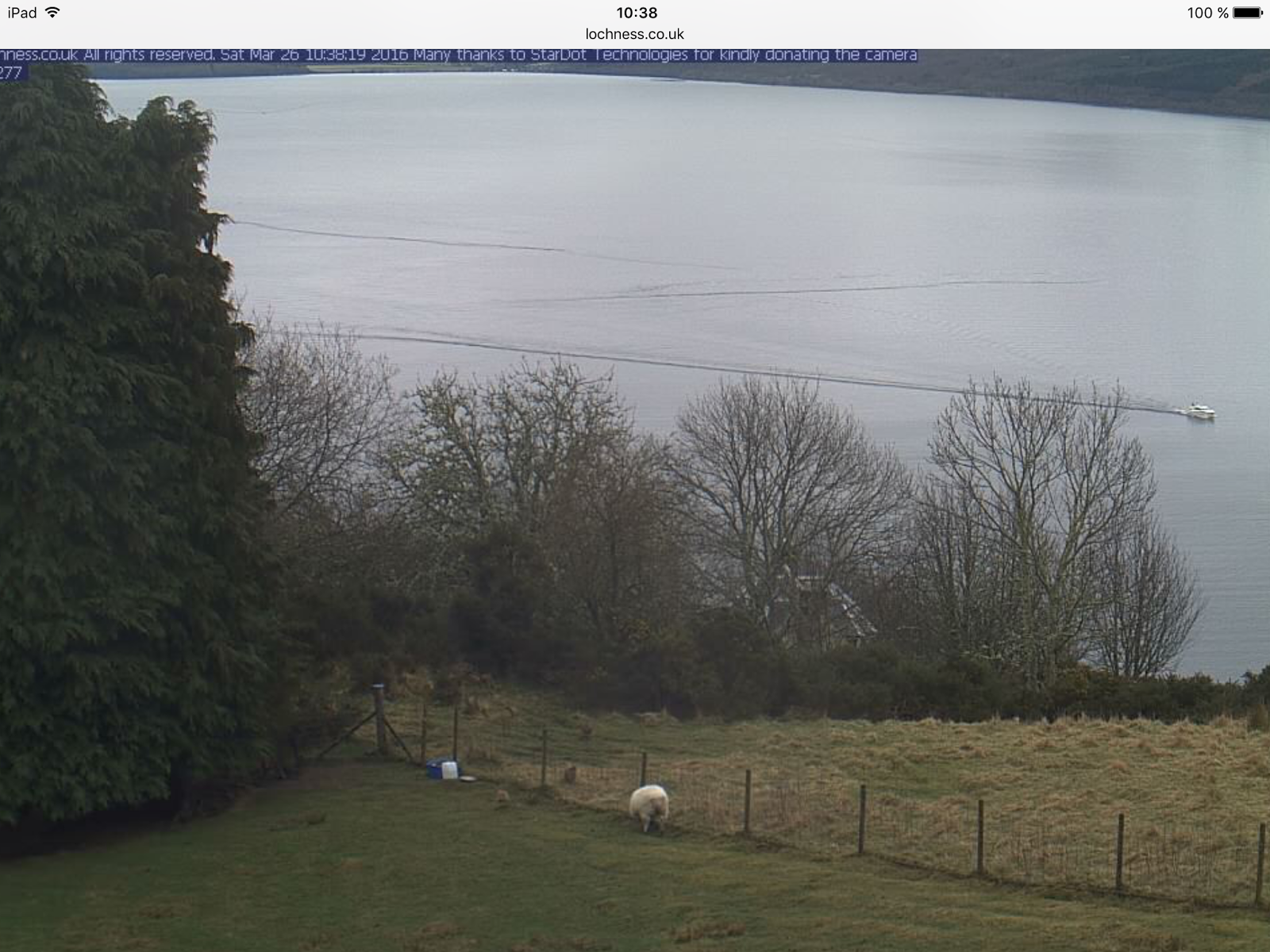
Joaquin is one of this blog's regulars, but he also likes to keep an eye on the loch via the webcam run by Mikko Takala at this link. I have had a few pictures sent to me by such users over the years and some have certainly looked interesting. More often than not, it is a case of selecting from a range of objects that are not necessarily monster. That is mainly down to the fact that the webcam must be at least 200 metres from the loch and too far for game changing pictures.

So, Joaquin has two snapshots he sent me. The first he took on January the 5th this year. The object did not appear on the next snapshot which would have been about 15 seconds later. The task is to identify the crescent like object just right of centre. Joaquin added some geometry based on a later picture of a Caley Cruiser to estimate the size of the object which he thinks is about 1.7m long and 0.5m high. I have not attempted to verify these estimates.


The second picture was taken about a week ago and shows a more blunted type of object protruding from the water just above the bottom right of the picture. It's doesn't look like a wave and not a log as it again disappeared on the next webcam refresh. Using another snap of a passing boat, Joachin estimates the object is half a metre wide and high.


I must admit it looked like a dorsal fin on first appearances, but we covered that argument in the recent F.C.Adams photo article. Readers are invited to suggest explanations and they don't have to be Nessies!

The author can be contacted at lochnesskelpie@gmail.com


Monday, 28 March 2016

Good Searle, Bad Searle

As part of this mini series on Frank Searle, there is one final question. Is there any side to the story of Frank Searle that is redeemable? If you felt his fist, were on the receiving end of his tongue, were duped by his fake photos or witnessed daubed castle walls and petrol soaked beaches, then it is unlikely that your mindset is going to be graciously inclined towards him in any way. 

What we know of him in writing is mainly from 1976 onward and by then the battle lines had been drawn between him and his perceived enemies. By then, the man Frank Searle was increasingly consumed by persons and events on the other side of the loch and became a man who spoke and acted through those red tinted glasses.

But when and how did it go wrong? Even those who hate him or hold him in contempt, will admit that the Frank Searle who turned up at Loch Ness on the 16th June 1969 was at best a different person or at worst had a different attitude. Indeed, Frank Searle goes further back than that as his autobiography tells us he annually took camping holidays from 1958 onward after being inspired by Constance Whyte's "More Than A Legend". Indeed, his first claimed sighting was of a single hump during such a trip in June 1965.

I, myself, find it unlikely that this Frank Searle arrived at Dores Bay with the intention of punching other researchers or churning out a series of fake photographs. Like Tim Dinsdale and Ted Holiday before him, it is likely his intention was to watch the loch and get that photograph of the Loch Ness Monster that would convince the world there was a case to answer.

Searle got his first published photo on June 27th 1972 (though he claimed to have got his first photo on November 10th 1971). That is shown below on this contemporary newspaper article. Assuming this is as fake as his other pictures, we could say this marks the beginning of the hoaxing period for Frank Searle. But what had happened in the previous three years?


Of course, one may conclude nothing happened for three years, much to Frank Searle's frustration and his eventual decision to "create" his own evidence. However, if you believe there is one or more large creatures in Loch Ness and you have a man initially and sincerely watching the loch for long hours for at least three years, there is a good chance he saw something.

What that could be is difficult to tell and perhaps Paul Harrison's upcoming book will reveal a more conciliatory Frank Searle who owns up but also tells us what he really saw out on the loch over 13 years. One thing is for sure, the seventeen sightings claimed by Frank Searle over three years in the article above is somewhat excessive, shall we say.

Finally, one point of debate concerns Frank's first photo shown above. This was originally pointed out by Jay Cooney on his Bizarre Zoology blog in 2013. It concerns an article on the Loch Ness Monster from the Illustrated London News of 13th January 1934. That article was a compilation of drawings made by an artist of various Nessie sightings up to that time.


The one of interest was seen by a Nora Simpson which I have scanned from my own copy of the magazine for a comparison with Searle's first photograph. There is more than a passing resemblance between the photo and illustration which raises several speculations. In both cases, we have the two humps, the suggestion of a tail at the right and at the front something smaller.


The first speculation would be a sceptical interpretation that Searle copied the drawing for his photo. That is, of course, possible, though Searle would have been nine or ten years old when the 1934 article was published. A search of the various books and magazines I have published up to 1972 do not reproduce this drawing for an adult Frank Searle to see. That does not mean that the article was never republished, time will tell.

The other option is that it is just coincidence, the other is that both drawing and photo represent a living creature in Loch Ness. I am taking no position on that particular point of conversation and merely throw it out as a conversational item.

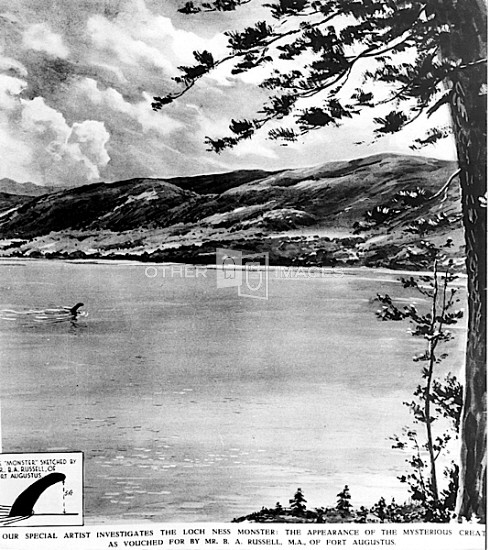
By the way, the Illustrated London News has a very nice painting of the B.A.Russell sighting from 1933, worth framing if you can get a hi-res copy.


The author can be contacted at lochnesskelpie@gmail.com


Tuesday, 22 March 2016

Gavin Maxwell's Loch Ness Sighting


A reader of this blog passed this clipping onto me which recounts the story of naturalist Gavin Maxwell's sighting of something strange in Loch Ness about 70 years ago. As you may know, Gavin Maxwell was the author of the acclaimed book, "Ring of Bright Water".


This was lifted from the Gavin Maxwell Facebook page, which had this to say:

During the late 1960's, a wave of sightings and press reportings began to take hold of the British public's imagination, on the existence of a possible monster in Loch Ness. I distinctly remember that Summer of 1969, as a boy of 11 years old travelling down with my family from Inverness to Arisaig and witnessing the hysteria of tourists jamming every layby down the A82. This wasn't helped by the various TV cameras set-up on timber custom-build platforms every 5 miles down the lochside hoping to bring 'live' sightings of 'Nessie'. An article in The Scotsman newspaper dated 2nd August 1969 confirms that even Gavin Maxwell was a believer in this mystery. This article was published just five weeks before Gavin Maxwell died on the 7th September, about the same time that Gavin realised he had cancer according to Richard Frere. This article was/is possibly the last published writings of Gavin Maxwell.

Gavin's account is known to Loch Ness researchers, but this account adds more detail. The earliest I know about it was a BBC television programme entitled "Your Witness" which debated the existence of the Loch Ness Monster in July 1968. The program sounds like a Who's Who of Nessie personalities from the time and even today would doubtless be well worth a watch. Those called as "witnesses for the defence" included Gavin Maxwell, and this is the account as reproduced in Peter Costello's "In Search of Lake Monsters":

It was in September 1945. I was driving from Inverness to Mallaig. The weather was dull, drizzle, flat calm, and about five or six miles on the Inverness side of Invermoriston I stopped to relieve myself. There was a knoll about 80 feet above the loch. While walking round the broom bushes on this knoll, I noticed what appeared to be a line of stones, a submerged wall stretching out from the shore, perhaps 20 to 30 feet in all, shining wet. Perhaps two minutes later I returned. The “stones” were not there: there was only a slight disturbance in the water which subsided very quickly. I waited half an hour and saw nothing more.

I must admit I like Maxwell's almost prophetic reply to the skepticism of today when he classes himself as no fool as regards the accuracy of what he saw and would probably not take kindly to someone taking him by the hand to "help" him in what "he really saw". Given his stated two years of sea observation and a lot more years as a naturalist who observed the moods of the Scottish landscape on land and water, I would class him as a seasoned and experienced witness.

Having said that, what did Gavin Maxwell see? He said he had driven south to a point four miles out of Invermoriston, that places us somewhere just north of the Alltsigh burn that runs into Loch Ness and is the location of the famous John McLean sighting about eight years before as well as the curious land sighting of Alfred Cruickshank in 1923.


I scouted this area last year in connection with the McLean and Cruickshank cases and one likely spot for Maxwell's story is shown below. This is the shingle beach that runs past the back of the Youth Hostel and I walked it from Alltsigh Burn northwards until it ran out.


The object was described as looking like a row of partially submerged stones commonly seen on drystone walls. Not being exactly sure how that would look, I did an search for some similar images and came up with the following pictures of submerged walls below, though I do not claim that they are an accurate representation of what Maxwell saw.


The suggestion is therefore that the appearance of the object is somewhat narrower compared to normal hump like reports. Did Gavin Maxwell observe the uppermost part of the creature's back as it lay still just under the water near the shore? 

Or was it a line of stones just as the description suggests? After all, the account says it ran perpendicular to and close to the shore line. For what it is worth, I walked along this area right up to Alltsigh Burn and I certainly do not recall a line of "stones" similar to that described by Maxwell (albeit 70 years later).

The main point, though is that the objects were not there when Maxwell returned from relieving himself a couple of minutes later. If they were still there, we would never have heard this story. His mention of drizzle allows for the idea of the loch level rising from previous rainfall. However, given that he returned only two minutes later, it is unlikely the loch level would have risen that quickly and certainly other stones round about would have given that explanation away.

In conclusion, Gavin Maxwell's experience is not one that is going to make it into the classic sightings list. The fact we know about it is more to do with the man rather than the story. Nevertheless, it has taken its place in Loch Ness Monster history and people will form whatever opinion on it.

POSTSCRIPT:

Doug, a regular reader and Nessie enthusiast, adds these observations about Maxwell and Loch Ness:

The Maxwell family connection to Nessie was probably the strongest via his brother Eustace. He had a boat on the loch in the early days of the search and was very active there up until his death. Ted Holiday mentions him directly in ‘The Dragon and the Disc’: ‘In 1969…Major Eustace Maxwell chartered a trawler and a crew of professional fishermen. Bringing these into Loch Ness, he trawled the bottom but brought up only leaves and some plastic bags. 

Hundreds of large hooks, baited with herring, were lowered to the loch-bed by cable but nothing relating to the mystery was captured’ (pp31-32). In a later chapter, Holiday also mentions that Eustace Maxwell had told him of a Nessie-type sighting of his own in Loch Fyne: ‘Major Eustace Maxwell told me how he once saw a huge hump projecting out of Loch Fyne which he took to be a sandbank. As the car moved behind some trees, he knew it couldn’t possibly be a sandbank. When the car was at once reversed to the original spot, the object had gone’ (p184).

I also recall reading in Douglas Botting's biography of Gavin Maxwell, ‘The Saga of Ring of Bright Water; The Enigma of Gavin Maxwell’ that when one of his otters (Edal) savaged a visitor (Margaret Pope), Maxwell was so frightened of the potential for bad publicity that he asked her to put the story about that she had actually been bitten by something while paddling in Loch Ness! Not sure if this story ever did fully do the rounds, but it's quite interesting grist for the LNM mill nonetheless.


The author can be contacted at lochnesskelpie@gmail.com


Friday, 18 March 2016

New Analysis of Nessie and Sea Serpent Reports


Charles Paxton has written on the statistics of aquatic cryptids before and has had a new paper published in the latest issue of the Journal of Scientific Exploration (Volume 30, Number 1). You have to become a paid up member of the Society for Scientific Exploration to access the article or wait two years for it to become free. I did get a copy from Charles having helped him on this article, so can make a few points.

The article is entitled Consistency in Eyewitness Reports of Aquatic “Monsters” and is co-authored with Adrian Shine. With Charles' permission, I include the abstract for the article below:

Little work has been undertaken on the consistency/repeatability of reports of natural historical  anomalies. Such information is useful in understanding the reporting process associated with such accounts and distinguishing any underlying biological signal. Here we used intraclass correlation as a measure of consistency in descriptions of a variety of quantitative features from a large collection of firsthand accounts of apparently unknown aquatic animals (hereafter “monsters”) in each of two different cases. In the first case, same observer, same encounter (sose), the correlation was estimated from two different accounts of the same event from the same witness. In the second case, the correlation was between two different observers of the same event (dose). Overall, levels of consistency were surprisingly high, with length of monster, distance of monster to the witness, and duration of encounter varying between 0.63 and 1. Interestingly, there was no evidence that sose accounts generally had higher consistency than dose accounts.

If you don't read the article, the one thing to take away from the abstract is the consistency between estimates of distance and size between multiple witnesses and multiple witness accounts. That, of course, does not equate to accuracy, but neither does it exclude it. Though there will be caveats, this can be taken as a positive for witness integrity rather than a negative. I say this because a low precision would not be consistent with high accuracy.

Charles' study used a dataset which was a combination of sea and lake monster reports. It would be interesting to see further results for the single case of the Loch Ness Monster. Note that this does not address the other issue of witness descriptions of what they see, which is a more complex affair than estimating a simple number.

On the cryptozoological theme, I note the same issue carries a review of a new by Karl Shuker entitled: "A Manifestation of Monsters: Examining the (Un)usual Suspects" and it is reviewed by a man well known to Nessie researchers, Henry Bauer.

The author can be contacted at lochnesskelpie@gmail.com


Thursday, 17 March 2016

You Can't Keep A Good Monster Down

After trying to ignore the Loch Ness Monster for years and diverting potential tourists to other attractions around the area, the tourist agency, VisitBritain, has decided to recruit the monster into their services with a promotion drive in France, Holland and the USA. The ad campaign cleverly uses some themes of monster hunting as a route into promoting other aspects of Highland tourism.

Back in  2008, a bid to make the Loch Ness area a UNESCO world heritage site carefully ensured no mention of the monster was made. One would have also thought the repeated attempts of sceptics to reduce the mysterious creature to logs, waves, birds and liars would have had its effect. Evidently not, people still like monsters while bow waves and cormorants don't cut the mustard.

From my own point of view, I am ambivalent about increased tourism around the loch. The increased traffic noise on the loch is, in my opinion, a deterrent to the creatures surfacing. That doesn't mean they never surface near boats, it just means that as the noise coverage over the loch increases, open water sightings proportionally decrease.

For me, it also makes it more difficult to find secluded spots for trap cameras as tourists like to clamber along the shore lines.  On the other hand, more tourists means more potential videos and photographs - assuming this is not cancelled by the increased noise. Oh well, maybe I should only come up in the winter.


Sunday, 13 March 2016

Frank Searle's Newsletters


This blog has brought you Rip Hepple's Nessletters and Tim Dinsdale's Operations newsletters. Now it is the turn of Frank Searle.

Back in 1969, Frank Searle arrived at Loch Ness with nothing more than a camera, a tent and a lot of hope. Seven years and several alleged monster photos later, he was elevated to the status of famous monster hunter which led to the publication of his book and the start of a quarterly newsletter sent out to a crowd of subscribers.

I haven't read all the newsletters, but they tend to start with Frank's own investigations as well as stories of other sightings from those who came to his camp. As the years pass by, the tone changes as he begins to criticise the activities of the media, commercial operations and other investigators. The last newsletter is dated December 1983 as he announces his impending departure from the loch. This final newsletter was published between the "petrol bomb" attack on Adrian Shine's boats and the fire at the Loch Ness exhibition that Frank Searle so hated.

The newsletter roster is incomplete as it lacks the issues for December 1981, all of 1982 and March 1983. The issue for 1976 is undated, so I am uncertain what may be missing for 1976 or whether the presumed missing dates elsewhere were actually published. If readers have any missing issues, feel free to send me scanned copies for inclusion.

The archive can be explored at this link.


Thursday, 10 March 2016

Talking Nessie with Bruce Collins

I was again interviewed on the mysterious matter of the Loch Ness Monster by Bruce Collins and you can listen into that tomorrow. He broadcasts on West Coast People's Radio.


Sunday, 6 March 2016

Who are the Monsters of Loch Ness?


With the upcoming book on Frank Searle, I was minded to follow up on a few things in advance to perhaps raising awareness of this topic. When you think of Frank, you think of personality clashes, vendettas and even vandalism and violence. However, the perhaps not so surprising thing is that this little piece of monster hunting history was only the most publicised aspect of a general thread that has run through the decades. In other words, monster hunters and ex-monster hunters are not some cosy conclave of nice but eccentric folks akin to bird spotters, but rather a microcosm of the all too inevitable failings of human nature.

Whether this sub-plot of rivalry played out in the early days of the Hunt is not so clear, but when large numbers gathered at the loch from the 1960s onwards, the ingredients for conflict also came together. Perhaps this is best summed up by Paul Harrison who went public with his views on 2001 when he wrote for the CRYPTO magazine:


To the unwary, Loch Ness is almost like some surreal real life fairy tale, tiny hamlets surrounding a huge expanse of water, exhibitions, tourist shops, whisky and the occasional ‘Monster Hunter/Researcher’ running around in search of the creature(s). To the tourist, a huge farce is played out as the so called ‘experts’ expound their own personal theories, almost demanding to be elevated to the position of world’s number one and sole expert on the matter.

Away from the tourists, these same ‘experts’ (they are indeed the only one’s who class themselves as such) appear to be hell bent on destroying not only the opinions of others but also on succinct character assassination. The reality with Loch Ness research is that it is a complete and utter mess, sighting reports (old and new) held by some and other valuable information is selfishly withheld by those who choose to keep it from the public domain, as these folks absurdly believe that their personalities are bigger than the tradition itself of the Loch Ness Monster. Virtually everything that can be postulated about the Loch Ness creature(s) has been printed in countless books, magazine articles and newspaper columns, therefore I do not intend to dwell on the subject, other than to say until serious and sensible cohesion can be brought to bear on research matters then the real search for the truth will never progress.

As for ‘lake monsters’ such as those believed to inhabit Loch Ness, perhaps the real monsters are of the human kind, whatever it is or they are that inhabit Loch Ness, they are not as mysterious as the personal politics involved in research there. Seals, boat wakes, eels, standing waves, floating logs, or just plain old hoaxes, Loch Ness will continue to be the epicentre of Dracontology and Cryptozoological matters, a great shame it could not set the ideal academic study and research example. Loch Ness is indeed the tip of the Dracontology iceberg, but its also drifting towards oblivion, a Cryptozoological subject which may be cynically dismissed by new researchers as ‘untouchable’.

When Paul speaks of those who wish to be seen as the "world’s number one and sole expert on the matter" or are "hell bent on destroying not only the opinions of others but also on succinct character assassination" I can readily empathise with that, having experienced it first hand for myself on the new platform of Internet forums.

Whether it is the same people involved in 2016 as in 2001 is not a matter I wish to pursue in this article. The point is that the problem has not gone away and it is appropriate that Paul is the author of this new book on Frank Searle entitled "The Monster Hunter - The True Story of Nessie and Frank Searle". That phrase, "the true story" implies there are things about Frank Searle that have been either omitted, exaggerated or just plain fabricated. What those are remains to be seen, but I have spoken before about Frank's unpublished second book, which was pulled after protests by Adrian Shine. That book was, until recently, available online. I note that link has gone dead, so you can now download and read the PDF from my own archives at this link.


It is a publication you should take with a pinch of salt given the high tensions of the period, but to state it is wholly fabricated is something that should also be taken with a pinch of salt. Apart from a couple of less than flattering claims made against a prominent Nessie sceptic often seen on cryptid Internet forums, the one that intrigued me most was the claim that Tim Dinsdale was at Loch Ness in April 1960 with another man with whom he later had an argument and was seen bundling into his car after he collapsed.

This sounds fanciful but is based on what a claimed local eyewitness who approached them told Searle years later. The fact that no one has stepped forward saying they were that mystery man seems to mitigate against it. Such are the claims and counterclaims of the Frank Searle story.

As a prelude to Paul's book coming out, I decided to look again at the infamous "petrol bomb" incident of August 1983. What we know of this mainly comes from those who were Frank Searle's enemies. Since the phrase "the victors get to write the history" is a truism even in the Highlands, I decided to look beyond these people. A search of the newspaper archives at the invaluable National Library of Scotland turned up two articles. The first is from the local Inverness Courier dated the 23rd August 1983. Click on the images to enlarge for reading.


The second comes from the Aberdeen Press and Journal of the 22nd August 1983.


Clearly, something happened on the 21st August 1983 when somebody lobbed a lit plastic bottle filled with petrol at a boat and somebody had daubed words against Adrian Shine on the walls of Urquhart Castle two days before. The Inverness Courier took a neutral stance in talking about an "alleged petrol bomb attack" and did not name any suspects. The Press and Journal had a similar approach but also mentions police involvement and the vandalism at the castle.

However, things get obscure beyond these newspaper clippings. A further search makes no mention of the outcome of this police investigation and no mention of Frank Searle. One can only presume the investigation fell through due to lack of evidence.

Mike Dash, Fortean researcher, wrote on this incident as he was there as a volunteer with the Loch Ness and Morar Project. He did not witness the incident at 5:30am but was there to observe the consequences. He said a female volunteer identified the man who threw the bottle from a photo of Frank Searle, but nothing came of this important witness evidence.

Combining this with Searle's account of the incident in his unpublished booklet, it would seem the police quickly visited Frank Searle at his Foyers base only to find him painting the ceiling of his small exhibition. They also asked him if he would take part in an identity parade, to which he refused since he claimed he was too well known to allow an unprejudiced procedure.

Searle's booklet makes no mention of the castle incident, let alone making a defense against it. Though he does argue against the petrol bomb incident, claiming that the idea was stupid since a molotov cocktail had to be made of glass and the waves were so high that morning they would have extinguished any flame.

A final source was a friend of Frank Searle by the name of Graeme Caisteal. He countered Mike Dash's account by claiming Frank had a prosthetic foot from his army days which would make it nigh impossible for him to clamber up to the castle and daub the walls. Perhaps, but he also said that the police found the engine of Frank Searle's boat to be stone cold and that there were a group of tourists there to vouch as alibis.

Frank Searle claimed he had an idea who perpetrated the bottle attack and claims he was set up. He does not name the person and we are left in the awkward position where Frank Searle is the obvious suspect, but evidently not obvious enough to press charges. Counter arguments can be made against such arguments as parties classed as monsters by the other party clash with all teeth bared.

As for me, I will simply await Paul Harrison's book to see what it has to say about that day on a shingle beach thirty two years ago. I do hope no one tries to block this book as they did with Frank Searle's.

Meanwhile, the envenomations will continue as personalities and agendas trump research in the great Loch Ness Monster debate!

The author can be contacted at lochnesskelpie@gmail.com


Thursday, 3 March 2016

Scott Mardis talks Plesiosaurs


Fellow lake cryptid fan and researcher, Scott Mardis talks about cryptids as plesiosaurs on Monster X Radio. Scott is one of the leading experts on the monster of Lake Champlain, commonly known as Champ. He also runs the popular Facebook group, the Zombie Plesiosaur Society, which you can find here.

Go this link for the podcast.

Sit back and enjoy this special edition of Monster X Radio: Animal Extant, Relict Plesiosaurs with special guest Scott Mardis. 

Monster X Radio: Animal Extant is a show about general cryptozoology and possible relict extant species that may still roam among us. Hosted by Mike Richburg and Dorraine Fisher, each episode will explore the possibility of the existence of mysterious unknown creatures and those perhaps thought lost to time. Future episodes will focus on the Mokele Mbembe, The Dogman, Lake Monsters, Megalodon, Giant Birds, Large Melanistic Cats, The Jersey Devil, The Chupacabra, and many more.

Scott Mardis has been an active field investigator of the Lake Champlain “Monster” since 1992. He is a former sustaining member of the defunct International Society of Cryptozoology and a former volunteer worker in the Vertebrate Paleontology Dept. of the Philadelphia Academy of Natural Sciences (1990-1992). He co-authored a scientific abstract about the Lake Champlain hydrophone sounds for the Acoustical Society of America in 2010. He currently lives in Bradenton, Florida.

Mike Richburg was born and raised in South Carolina, where he had an encounter with a Swamp Ape in 1978 that had a profound impact on the course of his life. Mike has since been very involved with Cryptozoological Field Investigation, interviewing eyewitnesses and investigating such things as The Lizard Man of Scape Ore Swamp, The Fort Motte Devil, The Dogman, Bigfoot, Lake Monsters, The Rimini Goat Thief, Giant Birds and Snakes, just to name a few. Mike is very much at home in the swamps of the American Southeast, and frequents places few others would. Mike previously was a part of The Big Thicket Watch, and CryptoLogic Radio.

Dorraine Fisher lives in Florida. She is an author, photographer, and team writer and associate for the research group, The Crypto Crew, who's written numerous articles on the subject of cryptozoology.

Saturday, 20 February 2016

Is the Hugh Gray Photograph a Swan?


The dog is dead, long live the swan!

In the midst of preparing a review of Darren Naish's new sceptical book,  "Hunting Monsters", I noted an opinion on the 1933 Hugh Gray photograph stating it was a picture of a swan.

The author is somewhat contradictory about the photo in that at one point he speaks of the "sheer ambiguity" of the picture yet later states with the usual sceptical certainty about these matters that it is "almost certainly" a swan. For about thirty years prior to this opinion, the prevalent sceptical view was that Hugh Gray had photographed a labrador dog swimming in the loch (or even elsewhere).

Apparently, that dog is now canem non grata (or whatever the latin is). It looks like the sceptics have finally accepted the "believers" were right about the "dog" in the picture being nothing more than an example of pareidolia (like seeing a face on a slice of toast). Don't expect them to thank us.

Now, I had actually been aware of this opinion doing the rounds on the Internet forums for a number of years. When it appeared I thought someone was having a joke. But now that someone is trying to elevate it to the ranks of not just plausible, not even probable, but certainty. In that light, it is time to expose the problems with this argument.

The first thing to note is the modus operandi of the sceptic. I have debated with and observed sceptics for over five years now and think I have a good handle on the way they try to persuade people of their arguments. To say it is all based on "logic" and "science" would be simplistic and naive. Too often, one will encounter more of the psychology, sleight of hand, straw men and ad hominems when dissecting sceptical arguments.

This particular sub-plot is no different. Observe the two pictures below which were published in defence of Darren Naish's reinterpretation of the Hugh Gray photograph. The top picture is a common image of the Hugh Gray photograph and the bottom picture is an idealised drawing of a swan in the "Hugh Gray" position.


We would be invited to note the apparently common features. The long neck, the body and the white feathered tip at the posterior. But, at best, this is a misrepresentation of the facts. At worst, it is deception. When I saw this pair of images, I asked myself two questions. The first was why they used this particular version of the Gray picture? It is a poor quality image and there is a far better one available. It is called the Heron-Allen image and is shown below against our theoretical swan.


Using this picture, we can discern some features which puts the swan interpretation on a  shaky foundation. If we zoom to the far right side, things become decidedly un-swan like. One is immediately confronted with something that looks like a fish head. Do fish heads grow out of swans' butts? Not unless genetic engineering is older than we thought! Those who unthinkingly say "pareidolia" may not have noticed that this "pareidolia" is casting a shadow on the water.

In fact, that whitish area that looked like the feathered tip of a swan's posterior is now resolved to something less substantial. It looks like spray water heading up vertically or it may be a light defect on the film. I am open to either, but it has nothing to do with swans.


A further examination of the superior Heron-Allen image betrays another problem. Where are the feathers? Try as I may, I cannot see anything that suggests feathers or anything avian. On the contrary, the image suggests a surface that is more smooth in appearance and contour.

There are other issues I would point out, but I will leave those for a follow up article as I expect an "academic paper" (I use the term loosely) to be published trying to push this fast crumbling theory. For example, someone is going to suggest (or rather tell us) that this is a double exposure and that opens a wonderful vista for sceptics as it allows them to tack on almost anything in their agenda against this picture. But that is for another day.

So why did the author use the inferior image when this superior image was available? My own opinion on this is that if the superior image was used, it would simply destroy the swan argument. The feathered tail would disappear and the curious fish head would appear. However, the more ambiguous inferior image better suits their case.

Darren Naish and his advisers on this matter know this superior image exists. Why did they not use it? After all, Steuart Campbell in his book "The Loch Ness Monster: The Evidence" was using it years ago. You now see what I mean by the psychological tactics of convincing readers as well as the scientific.

The second question I asked myself was why they used a drawing of a swan instead of a real one? The problem with drawings is that they can easily be drawn to fit the theory. It is no surprise that Darren Naish's swan looks like the Hugh Gray object.

Or does it? A quick use of picture software allowed me to overlay the swan drawing over Hugh Gray object. You know what? They don't even fit. If you align the neck and shoulder to fit in proportion, the problem becomes apparent. The Hugh Gray creature is far more extended that our theoretical swan. So we have a swan with a fish head growing out of its butt which is about twice as long as a normal swan. This bird gets more cryptozoological than the Nessie it is trying to get rid off!


CONCLUSION

Whatever you may think of the object in the Hugh Gray photograph, you should remove "swan" from your list of possibilities. I am astounded at the level of scepticism today when such explanations are trotted out with no proper due diligence on their validity. Critical thinking has grown fat, lazy and complacent in its pursuit of truth. In fact, do sceptics even believe these theories themselves or is it all a matter of getting rid of that troublesome monster?

Why Darren Naish allowed himself to be suckered by whoever he consulted on this matter is a mystery. Sceptics do not critique each other, I established that years ago. He should have asked me about this picture, but I won't be holding my breath over sceptics asking believers about anything. They hold us in too much intellectual contempt to "lower" themselves to that level!


Thursday, 18 February 2016

And the Winner is ...

The votes are in for the Inverness Courier and William Hill Best Nessie Sighting of 2015 and it goes to Conor McKenna and his sighting of September 15th. He saw what he described as a 15-20ft long object lying in the water which had a wave breaking against it before it disappeared.

A good sighting, though since Mr McKenna was driving, I doubt he could concentrate on the sighting as long as necessary for fuller details. Note the comments about people being reticent about coming forward with their sightings for fear of sarcasm. Such is the repressive atmosphere sceptics have created with their dumbing down of witnesses. We salute those who still come forward with their accounts.


Original link here.

AS a former Gulf War veteran, Conor McKenna often notices things which seem out of the ordinary. His sighting of “something” inexplicable on Loch Ness as he drove along the A82 has now netted him first prize in the annual Best Nessie Sighting contest, sponsored by bookmaker William Hill and decided by Inverness Courier readers in an online vote.

The Inverness lorry driver was one of four contenders in the competition for sightings during 2015. Although his was one of two verbal accounts, while the other two were accompanied by photographs, his encounter was reckoned by voters to be the best.

He wins £1000 cash prize plus a £100 bet to place on the winner of the William Hill Scottish Cup. The other three entrants will receive a £50 bet. Mr McKenna, who previously served with 1st Royal Irish Regiment and saw action in the Gulf War in 2003, was delighted but surprised when told the news.

“It’s not often I am stuck for words but I am this occasion,” said the 32-year-old, who lives with his wife Eilidh and their eight-year-old daughter in Maclennan Crescent, Merkinch. “We have a baby due in April and we are also having to get a new bed for our daughter. We have been scrimping and saving, so this has come just at the right time.”

Mr McKenna, who works for Helmsdale company EM and T Rapson, recalled his encounter on September 15 when he was on one of his regular routes north along the A82. About a mile south of Urquhart Castle he spotted a dark-coloured 15-20ft long object in the water. “It was long enough, whatever it was, to leave a crest,” he recalled. “A wave broke on the left-hand side and I wondered if it was a log or a tree, but then it disappeared.”

As he was driving at the time Mr McKenna was unable to take a photograph. “I don’t really know what it was except it was big enough to make me question myself, and I don’t like that,” he said. “I didn’t discuss it at the time with my wife as she would have thought I was mad. Also, she gets annoyed because I am ex-army and always observing and spotting things which don’t seem quite right. I told two other people who just laughed and asked whether I was driving or sitting in the pub!”

Mr McKenna regularly drives along the A82 but has not spotted anything unusual since. Eventually he registered his sighting with Gary Campbell, who keeps the official register of sightings of the Loch Ness monster. Mr Campbell said of Mr McKenna’s entry: “What it shows is that there is a guy local to the area who drives up and down Loch Ness and sees something different.

“He is willing to stick his neck out and say he saw something but doesn’t know what it was. “I am sure there are lots of people who see things and don’t tell anyone because they are too embarrassed.”

William Hill spokesman Rupert Adams agreed. “People are always nervous about saying they have seen something because they don’t want to be a figure of fun,” he said.