I received a message from another Nessie fan, Paolo Boccuccia, about a story he heard back in 1983. This was Paolo's second visit to the loch in four years and he wanted to ask various local people who were older whether they had seen the monster. One lady, who Paolo thinks was a Mrs. McKenzie claimed to have had a land sighting back in the summer of 1922 near Borlum Bay. Paolo from here refers to the notes he made at the time rather than remembering the conversation thirty seven years later.
Reclaiming the Loch Ness Monster from the current tide of debunking and scepticism. If you believe there is something strange in Loch Ness, read on.
Wednesday, 11 November 2020
A Close Encounter with Nessie?
Monday, 2 November 2020
Another Book and its relation to the latest Sonar Contact
A month or so ago, I was looking for four small books to complete my collection of Loch Ness Monster books. I wrote on how I got Constance Whyte's 1951 booklet on the monster and now I have obtained a copy of Ben Sensical's 1982 booklet, "Loch Ness: An Explanation". As it happened, I was contacted by another Nessie fan who was lucky enough to have bought a copy last May and he sent me a photo of the cover for my occasionally updated article on Loch Ness Monster books. Fortunately, he was kind enough to let me buy it from him for the price it cost him, so thanks again! That now leaves me with two remaining books to find. I wonder how easy those ones will be to find?
But this booklet turned out to be a well timed purchase given the publicity concerning the latest sonar picture of the Loch Ness Monster taken by Cruise Loch Ness. I say that not in the sense that the author has anything to say about sonar, but because the theory he expounds is being expressed in some form by those trying hard to debunk and dismiss this important sonar contact. To cut to the chase, there is a sceptic by the name of Dick Raynor who was once a believer in monsters in Loch Ness but departed from such a mindset, probably in the 1980s, when scepticism began to rise in influence. This is what he recently said on Steve Feltham's Facebook group:
... there is every reason to recognise this as a sonar target, but there are lots of things that get washed down to the bottom of lakes. The wrapping from silage and straw bales could be carried down by the inflowing river currents and be buoyed up from the bottom by natural gases from the sediment. Genuine sonar target, yes. ID as a 'creature' - I'm not so sure.
It can be stated immediately that hours of television observation of the loch floor in deepwater have revealed no more than occasional twigs projecting from the fine silt. If logs are present here, they are a rarity. Intact leaves find their way into the sediment, but at a temperature of 5‑6 oC decomposition is slow. No sign of gas bubbles can be provoked by probing the sediment in front of the camera and no gas has been observed in cores or other mud samples brought rapidly to the surface. Loch Ness should not be visualized as a stagnant pond.
Note here two things. Again, gas production is next to non-existent. Secondly, there was no or little trace of anything which could register on sonar, be it tree trunks, silage or hay bales. It seems that if they even make it to the loch bottom at all, they just sink without trace, never to be seen again. We can now say the same about Dick Raynor's theory. Nevertheless, I am surprised he even suggested this theory. After all, he is put forward as an expert, so why was he not aware of this work by his long time associate, Adrian Shine? Then again, perhaps he was. While we are here, here is another paragraph from the work of the Loch Ness Project sonar work:
In shallow water, Trout have been observed to shoal on the approach of a diver or television camera. Fish concentrate inshore, within the scattering layer and in autumn loose shoals are to be found at the near surface. None has been observed in deep water. Shoals often exhibit 'tails' on echo‑sounder records, due to inter‑reflections between the fish returning over an extended period. Only one of our contacts showed any vertical extent on the record.
...
Nevertheless, contacts of interest, in terms of strength (sometimes considerable), depth and possible movement, do occur. By establishing a background against which anomalies may be judged, it is recognized that overlaps sometimes exist in all three criteria, with the presence and behaviour of the known fish population. On the other hand, superficially pedestrian explanations, such as a record‑class salmon in the main water column, deep swimming fish shoals and midwater logs, can all be seen to represent anomalies in themselves.
There you have it, anyone trying to fob off this new sonar contact as a big salmon, fish shoal or a floating log is deemed to be peddling "superficially pedestrian explanations" by the Loch Ness Project. We can now add silage and hay bales to the list of superficially pedestrian explanations.
The author can be contacted at lochnesskelpie@gmail.com
Monday, 26 October 2020
Adrian Shine describes a good Nessie sonar contact
Back in October 1987 we had the million pound Operation Deepscan run by Adrian Shine. It was a worldwide media event as attention focused on what a line of cruise boats armed with Lowrance sonar units would reveal in the depths of the loch below. If you jump four minutes and zero seconds into this typical media piece on the Loch Ness Monster at this link, it shows an archive piece of Adrian discussing the kind of sonar contact the operation would be looking for. To quote Adrian:
What we really want to see right now is a lovely crescent shape about half way down the chart.
So has Adrian's wish now been fulfilled? That looks like a lovely crescent shape to me. Now speaking of Adrian, in the light of Cruise Loch Ness producing a second, but not as good, sonar image, Craig Wallace of Kongsberg sonar products has offered their services in a more precise search. It looks like my previous article where I suggested his company's products could make a return visit has become a bit prescient.
The author can be contacted at lochnesskelpie@gmail.com
Thursday, 22 October 2020
The Latest Sonar Contact of Nessie
It has been a while since we had a sonar contact story from Loch Ness, but we have a good one here. The Mail on Sunday got a hold of the story and published on the 5th October. The gist of the main story is reproduced here for the record (these original links do sometimes disappear after a while) and I suspect the original print article had more information:
Saturday, 3 October 2020
Some good evidence coming up?
Steve Feltham posted this yesterday on his Nessie Facebook group:
So much driftwood,
So many boatwakes,
So many false alarms and out and out fakes.
For so long now we have been searching for that definitive, game changing piece of the jigsaw puzzle.
Decades can pass between one great piece of evidence and the next.
People ask me if I ever lose heart?
I have been constantly excited by the unpredictability of this mystery, there has always been something coming over the horizon, the next game changing twist in the pursuit of an explanation.
Strap yourselves in!
The next game changing piece of evidence has breached the horizon!
...and its the best I've seen in decades.
Can't say any more yet.
Naturally, this has got a lot of people excited and I await with some degree of anticipation what is about to be revealed myself. Is it a series of still images or a video or perhaps a sonar trace? Perhaps it is none of these. Steve says it is the best evidence he has seen in decades. Is that the best since the Dinsdale film or Rines body photo or Johnston photos? Well, I cannot be sure since my idea of best evidence in decades is not the same as another monster hunter's best. But it is described as "the next game changer" which is a phrase carrying a burden of expectation with it.
So, if it is such evidence, that means whatever media outlet will publish it also had to pay up. The better the images, the higher the fee. When such items come on the market, they are not just published with minimal checking such as the obvious bobbing log recently filmed at Dores Beach. No, one would expect that they are sent to people who try and test the claims to destruction. In the past, people such as Adrian Shine or others have been called in to assess images and testimony to provide an "expert opinion". Sometimes that opinion is not so expert but sceptics will never accept any images as proof of the Loch Ness Monster.
That's why the media can always rely on them to provide reasons why images should be treated with suspicion. These opinions may even move a media outlet to drop the items and the image owner moves onto the next newspaper. Anyway, once both sides of the fence have had space to investigate and contracts are signed, the images are published. At the end of the day, I hope this evidence is of such a rugged nature that even the sceptics are scrambling for excuses.
Steve, I've strapped myself in.
The author can be contacted at lochnesskelpie@gmail.com
Tuesday, 22 September 2020
Podcast on Loch Ness Monster
Andy McGrath of "Beasts of Britain" recently interviewed me on the Loch Ness Monster. We covered various topics in a discussion lasting over an hour. You can listen to it on YouTube or via his Google Podcasts webpage.
Now, is that the infamous Searle brontosaurus image I see in Andy's graphics above?
The author can be contacted at lochnesskelpie@gmail.com
Sunday, 13 September 2020
Excellent!
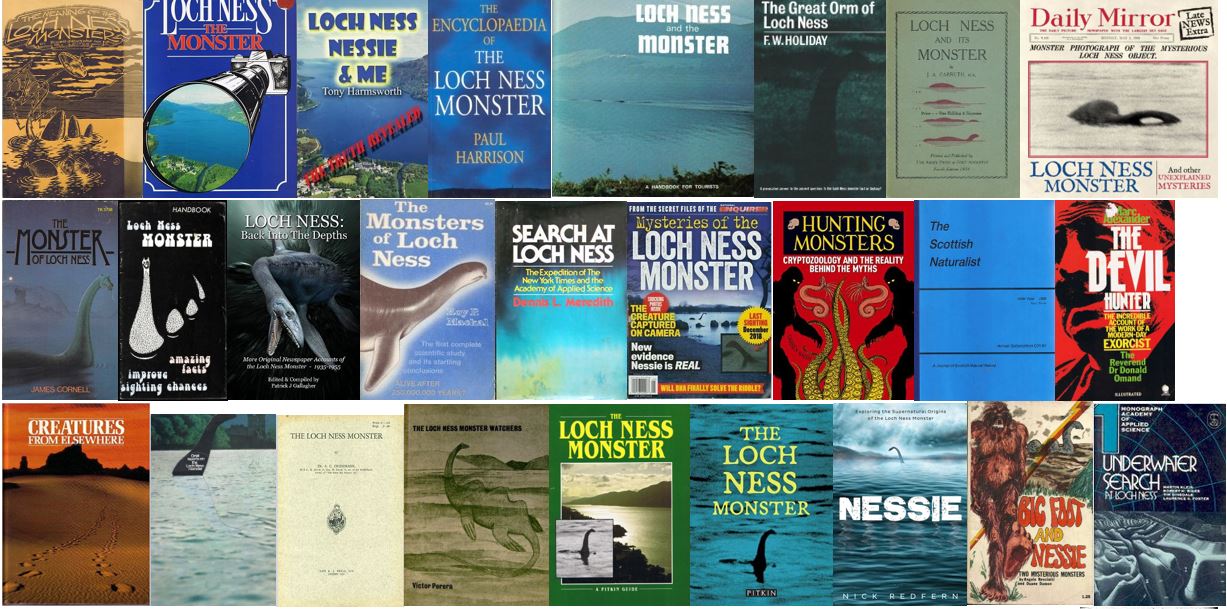
I have been collecting books on the Loch Ness Monster since I was a kid. Back then I had the well known titles such as "Loch Ness Monster" by Tim Dinsdale, "In Search of Lake Monsters" by Peter Costello, "The Loch Ness Story" by Nicholas Witchell and "The Great Orm of Loch Ness" by Ted Holiday. After a hiatus of some years, I went back to collecting monster titles in the late 1990s and it has grown steadily over those years but tailed off as nearly all the titles came into my possession.
Some take a lot longer due to their rarity and when they do come up, a bidding war may ensue. So it was with Constance Whyte's "The Loch Ness Monster" published in 1951. It is a small work of fifteen pages and is a prelude to her greater work, "More Than a Legend" published six years later. I actually put out scanned copies of this booklet a few years back and you can read them here. But I did not own it and had to consult a library copy. Now the booklet did appear on eBay about six years ago and the bidding went up to about £250. I was not the highest bidder.
Last Tuesday another copy appeared with a Buy It Now price of £10. That is good and bad at the same time. It is good because you will get it at a great price. It is bad because others will be looking for it. When I got the eBay alert to its presence I was surprised no one had grabbed it hours before. Providence was on my side and I had no hesitation in clicking that buy button as fast I as could. The booklet is now sitting proudly amongst my other Nessie books.
How much is the booklet actually worth? Ten pounds or two hundred and fifty pounds? The answer is whatever someone is prepared to pay at the time. It may be another six or seven years before another one appears, so I would rather not wait for the next opportunity. But who knows? Another may appear in a matter of weeks. We shall see, but the problem with being a collector is that the more you collect, the less there is left to collect. There are now only three titles I do not possess and they are all booklets. I have never seen any of them on eBay or on the leading second hand book websites. It may therefore be reasonable to conclude that there is no one on earth who has the complete collection.
As befits a serious collector, I have also collected the various revisions and reprints of Nessie books. For example, Tim Dinsdale's aforementioned book went through four editions and all were updated in line with Tim's adventures and the latest news from the loch. Other titles were republished with the exact same content, so it seemed unnecessary to me to buy them. Of course, new titles continue to come onto the market, the last I think was "The Loch Ness Sea Lion" by Rob Cornes back in August 2019. Stories, films, photos and investigations always appear each year, so there is always scope to publish a new book on the subject.
Anyway, here's to all the Nessie books out there, the good, the bad and the ugly! With apologies for any omissions.
The author can be contacted at lochnesskelpie@gmail.com
Sunday, 6 September 2020
Possible Nessie Photos from 2005
Thursday, 20 August 2020
The Monsters of Achanalt
Achanalt is a small village on the road between Ullapool and Inverness in the Highland region to the north and west of Loch Ness. It has a nondescript loch amongst other nondescript lochs in this lonely wilderness setting. However, back in 1935, a man by the name of Robert Lawson Cassie (b.1859) came forward with some incredible tales of monsters swimming in these lochs and rivers. The cryptid stories appeared in two books entitled "The Monsters of Achanalt", volumes one and two. These were published in 1935 and 1936, created a minor stir and then disappeared from view as general interest in Scottish loch monsters waned. But first, where is Achanalt on the map of Scotland? The general locality is circled below and is about 40 miles from central Loch Ness.
Zooming into that area reveals various small lochs and lochans and river systems surrounded by general mountainous terrain with a small population. Loch Achanalt (centred in the picture) itself is described as a body of water about three quarters of a mile across and a maximum depth of nine feet. You could walk around the loch in about half an hour. This is no more than a puddle in terms of lochs and would have escaped our notice if Cassie had not taken up his pen. However, other local lochs of various shapes and sizes are included such as Loch Rosque, Loch Crann, Loch Culan, Loch Luichart and Loch Garve.
By dave conner - originally posted to Flickr as Wester Ross - Loch Achanalt
But to give a flavour of what Cassie talked about, I quote two stories about monsters he claimed to have sighted with friends.
A VISIT TO THE WESTERN WATERSHED
On Thursday, August 29, I ordered a motor car from the Achnasheen Hotel. We left the Auld Hoose at 2.30 p.m., and our journey was by Achnasheen Loch Rosque, Loch Crane, past the watershed, the highest point on the Glen Docharty road, and down the brae as far as the vicinity of Kinlochewe, where we finished the outward trip. Our party consisted of Mr., Mrs., and Master MacMahon, Aberdeen; Mrs. Macrae, the Auld Hoose, Achanalt; the chauffeur, and myself. Stoppages were made at convenient points for scrutiny of the rivers and lochs. Creatures of varying sizes were noticed where the river was easily visible. Loch Rosque is about six miles long by half a mile wide. For the greater part of its length it is screened from the road by trees. We stopped twice at gaps in the wood before reaching the west end, where we made a very thorough survey. At the breaks I was able to distinguish at least a dozen of the immature reptiles, mostly about mid-loch, and showing only the briefest glimpses in the rough water. It was impossible to guess at their length. In most cases they escaped the notice of my companions, but experience made them unmistakable to me. Stopping at the western end of the loch, we all saw a number of large reptiles — about six at one time. general trend of their progress was across the loch to the brae of the south shore, where there was a tendency to leave the water at the base of the high hill that rises steeply from the loch. Their probable lengths would be from thirty to fifty feet.
Mr. MacMahon took various photographic exposures under favourable conditions. Proceeding a short distance farther, we left the car when we reached the nearest attainable point to loch Crann. It is a small, roundish, pond-like loch joined to Loch Rosque by a short and narrow stream. Reptiles were seen in this burn, and there were some five longish ones visible in Loch Crann itself. As they were partially submerged, approximate lengths could not be guessed at, but in my considered opinion, fifty feet average would be a safe estimate, perhaps erring on the side of moderation. They were not active, and their poses did not lend themselves well to photography; but Mr. MacMahon took several exposures, including that of a contracted or dinosaur-like pose of an animal seen on the brae, several yards from the bank, at the foot of the southern ben. Here I may interpolate that they seem to be landing in swampy places fairly often. On our return journey we noticed a slender form, a few feet long, motionless on a gravelly spit at a bend in the river. There is an extensive region of dry land at the watershed. For a mile or so we followed the course of a small burn that flows west to Loch Ewe, but it seemed too shallow to be the abode of reptiles. At any rate, no sign of life was observed in it. We saw two small reptiles, however, in the burn that feeds Loch Crann from the west.
EXPLORATION OF THE EASTERN WATERWAY
On Friday, August 30, 1935, we scanned the lower reaches of the waterway as far as the Upper Blackwater - i.e., for some distance along the course of the river, after it leaves Loch Garve. This time the car came from our obliging friend, Mr. D. Mackenzie of the Garve Hotel. The party consisted of Mr. and Mrs. A. W. MacMahon and their young son Michael, Miss Jean Macrae, the Auld Hoose, Achanalt; Mr. Roderick Macrae, chauffeur, Garve Hotel; and myself. We left the Auld Hoose a little before 5p.m.
Loch Achanalt is now very populous, and we had a passing view of some of the creatures in it. From prolonged observations I consider that the northern section of the loch now contains reptiles up to fifty feet in length, while there are many measuring between ten and thirty feet. Their characteristics have been described in previous chapters. The southern or Badluchie side of the loch is nearly shut off by a long tongue of grassy land, leaving only a narrow strait of communication. For several weeks past, dating from a heavy rainstorm and inundation, there have been indubitable signs that the southern loch contains one or more creatures of incredible dimensions.
From the Auld Hoose, a mile or more away, I daily see a long and high "plough furr" crossing the loch from north to south. Any curve of extra length cannot be determined. But it is alive and moving. The humps and elevated ridges along its back cannot be mistaken, and - perhaps from its very length - it behaves very differently from the smaller reptiles, and is far less elusive. It bears a marked general resemblance to pictures of the sea-serpent appearing in the current literature on the subject.
I ought to have inspected this stupendous animal at close range,but I suffer from various disabilities. The walk over rough ground taxes my powers. The river is spanned by a long, swinging bridge with ricketty planks, causing an uncomfortable feeling of tension. Lastly, one has to cross a marsh tenanted by a black bull of uncertain temper. Providence, however, has enabled me to get a very near view of this animal, or his double. On Thursday, August 29, 1935, between 11.30 and 12 noon (the time was not exactly noted) I left home in the company of a witness of unimpeachable credence in every respect. At a distance of about thirty yards we saw the high back of a reptile gliding up the river. Our field of view was somewhat restricted by out-buildings. This creature took quite a number of minutes, moving at a slow rate, to pass our point of observation.
Proceeding to the road giving a complete view of the river between two bends, we saw the animal still slowly coming up. At the bend next us it seemed to dispose of its head and foreparts deeply in the water, under the east bank. I marvelled for some minutes at the manner in which it could be stowing itself away. Suddenly a whirl of numerous flat-topped humps, black or dark in colour, appeared in the nook at the east bank. The creature was turning! The process was a long one, and an elongated shape had lengthened well down the straight section of the river, between the bends, before the reversal was completed. So far as the witness and I could see, the length of the creature was about the distance between the two bends. I estimate this distance at three hundred yards or nine hundred feet. A local friend of great experience confirms my view.
So what are we to make of these fantastical reports? The answer is simple, they are all fabricated nonsense. No one else ever corroborated such reports and, despite being told of various photographs of these creatures being snapped, none of them make it into Cassie's two books. The almost monotonous appearance of these creatures makes them easier to spot than deer and perhaps even sheep. The description at the end of a nine hundred foot serpent struggling to contain itself in a comparable river is surely designed to elicit sceptical reactions in even the most gullible believer.
One of the witnesses was an A. W. MacMahon of Aberdeen who took various photographs. A search of the online newspaper archives does reveal an A. W. MacMahon who ran a photography business in Aberdeen at that time but no mention of monsters. So the co-eyewitnesses likely did exist, but they were just in on the joke. But it has to be asked what made Cassie write such garbage? One clue is in a newspaper clipping from the previous year in which he claims a sighting of the Loch Ness Monster. The headline below is taken from the Aberdeen Press and Journal dated 25th June 1934.
The Aberdeen Press and Journal had published some of Cassie's previous books, so it is no surprise they take up his story. In this story, Cassie is again with a Mrs. MacRae and Mr. Healy, a chauffeur of the Garve Hotel. This report was not in the eyewitness database I use, so it was new to me. An examination of it gave me some doubts about it. The "disporting itself vigorously" involved Cassie's creature taking a sequence of leaps out of the loch in Urquhart Bay near the castle at 45 degree angles to the water revealing a roundish body and ending in a big splash and spray of water. I presume he had the idea of a humped back whale or a dolphin breaching the water as it leaps out.
The reason I have my doubts about this story is because I can find no other account in the stories of 2000+ witnesses that mentions such a breaching action. I therefore conclude the creature does no such thing and Cassie has made the whole story up by overdramatising it. However, his Achanalt stories would already have cast doubt upon anything he would say. Another account of Cassie's stories can be found in an article by Mike Dash in Fortean Times No.177 from 2003. He states that Cassie claims the Achanalt monsters began to appear in June 1934 which is the same time he claimed to have seen Nessie. I suggest this coincidence is no coincidence and rather denotes the time Cassie decided to embark upon his tales of deception.
Why June 1934? Well, stories of the Loch Ness Monster had been steadily rising since the summer of 1933, but Nessie fever was about to peak in July 1934 and news of the monster was just about everywhere all the time. That month of July would prove to be the busiest month right up to the present day for monster reports. As an undoubted sceptic of anything monstrous in any loch, Mr. Cassie must have been quite fed up with the coverage by June and was no doubt convinced anyone could submit a report and be published. With his reputation as a local and respected author, he put that to the test and was proven right.
The resulting mix of satisfaction and disdain he must have gained from that initial toe dip into the media would have emboldened him to expand the story into his basically satirical work on loch monsters in the region of Achanalt. His book was an attack on believers and not sceptics. However, he could not continue his story at Loch Ness as it was too busily watched and so he moved the story to the relative solitude of the hill country of Achanalt where Cassie (pictured below) lived.
So the booklets were published, nobody believed them, but that was not the point, it was Cassie's own personal commentary on the Nessie mania of 1933 to 1934 and his contempt for anyone who genuinely or ungenuinely claimed to have seen them. It's a pity he did not make a better attempt to properly evaluate eyewitness reports. That task was left to his contemporary, Lt. Cmd. Rupert T. Gould. I wonder what he made of Cassie's pack of lies?
The author can be contacted at lochnesskelpie@gmail.com
Thursday, 13 August 2020
Loch Ness and the Scientists