Sunday, 21 August 2022

The Surface of Something


Forty seven years ago, a private meeting in the USA was held by Robert Rines of the Academy of Applied Science to which author Nicholas Witchell was invited to view the best of the underwater pictures taken at Loch Ness on June 19th 1975. Penguin Books subsequently rushed a new paperback version of Witchell's "The Loch Ness Story" to tell of the photographs which would now place the Loch Ness Monster under the discipline of zoology and not cryptozoology. The final chapter tells us that the order of notable slides was an upwards view of the boat from which the camera rig was suspended, the body and long neck, the gargoyle head and one final slide:

The final good picture showed the underbelly of the animal as it passed immediately above the camera. A cylindrical object stretched across the whole frame. The most noticeable feature of this was the covering of what were evidently parasites hanging off the belly. As we went through the whole sequence of pictures again, Bob described the reaction of a group of experts from the Smithsonian Institute who had flown over from Washington the previous day to see the pictures. Headed by Professor George Zug, the head of the Reptiles and Amphibians Department, they had been utterly amazed at what they had seen. They had, he said, noticed details which only the trained zoological eye would see; for instance on the underbelly picture they had been particularly interested by the parasites and there had been speculation that a dark area towards the left end could be the creature's anal fold.

This is the third in a series of articles on the 1975 underwater photographs taken by Robert Rines and the Academy of Applied Science. You can get the background on these famous pictures from the two previous articles here and here. I actually had not intended to write any third article until a fellow Nessie researcher got in touch with me. He pointed me to an archive of photographs maintained by MIT, the Massachusetts Institute of Technology, which includes photos taken by the technical people from MIT involved in the 1975 search, namely Martin Klein on sonar and Harold Edgerton on optics.

Most are pictures of people directly and indirectly involved in the hunt, places around the loch, Martin Klein's sonar work and Harold Edgerton's underwater camera work. It is a fascinating collection of a time when people thought the monster was almost within their grasp. The Edgerton collection homes in on the underwater camera work done in Urquhart Bay under the auspices of the Academy of Applied Science. Most of the photos revolve around the ones we know about, the gargoyle head, the long necked body and so on. 

I had looked through some of the hundreds of pictures in the archive and then my fellow researcher pointed me to the image at the top of this article which could be a candidate for that "final good picture" mentioned by Witchell above. The fascinating thing is that I have never seen this photograph before in any book, magazine, discussion, web page or TV documentary in the decades I have been following this mystery. It was perhaps mentioned in words in some publications, but I would have assumed it was something else. The classification of the picture on the MIT website is as follows:


Water surface, Loch Ness (?) (Scotland, UK) - n.d.

Major collection: Science & Technology

Named collection: Harold E. Edgerton Collection

Object type: color slide

Maker: Edgerton, Harold Eugene

Place made: United States

Materials: 35mm film; plastic

Site location: Scotland, UK

Measurements: 2" x 2"

Surface of water on lake at Loch Ness (?) in Scotland, UK. DUPLICATE (CC)


I will now look at the pros and cons of whether this is a photograph from the 1975 expedition and if it is of the loch bed. The classification is uncertain as to when and where this was taken and suggests it is the surface of the waters of Loch Ness. It appears as if the curator has no backstory to it from anyone involved in 1975. Having looked at untold number of pictures of the watery surface of Loch Ness, I am certain the features on this surface have little to do with water and more to do with a solid surface. Let me now explain why I think this photograph could be the one described by Nicholas Witchell. First, he says the object is above the camera. To give some context here, the setup of the 1975 camera rigs is shown below.
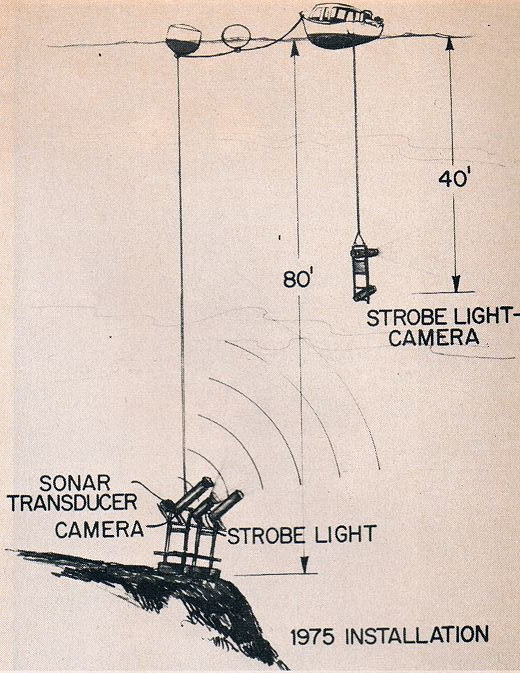


The camera in question was the old 1972 strobe light camera rig here suspended at a depth of forty feet. It had been reconfigured to put the camera five feet below the strobe and tilted upwards to avoid back scattered light. Nicholas described the surface as stretching across the whole frame as this image does. He describes it as cylindrical and this could be argued from the bottom of the feature where we see what looks like a foreshortening perspective of surface features as they recede into shadow consistent with a cylinder. 

He also describes the surface as "above" the camera. Since the camera is pointing upwards, one may take this as a given, but if, for example, only the top of the surface was visible and it occupied the lower part of the picture, one could say it was in front of the camera rather than above it. Then we have the speculative mention of parasites and an anal fold to the left. The annotated picture below explains how these descriptions would line up well with the image.


Of course, the matter of anal folds and parasites is secondary as to what we are actually looking at in its entirety and so such speculations are set aside. Thus if we assume that this is the image that Nicholas Witchell was talking about, that leads us now to speculate on what is in the picture. Back in 1975, the AAS team were sure the mid-water camera rig never went near the loch bed and so anything photographed was also in mid-water. 

However, it is now accepted that the boat from which the rig was suspended was prone to drifting under the loch winds and could reach shallower waters and drag the rig along the loch bed whilst taking pictures at about one minute intervals. What is uncertain is how much this coincided with the photos taken on the night of June 19th into the 20th. For comparison, here are some shots of the loch bed taken during that time. The first was a calibration shot and the second was taken on the 19th June (we shall return to this shot later). The third shows the effect of silt disturbance which was especially evident in the famous gargoyle shot.

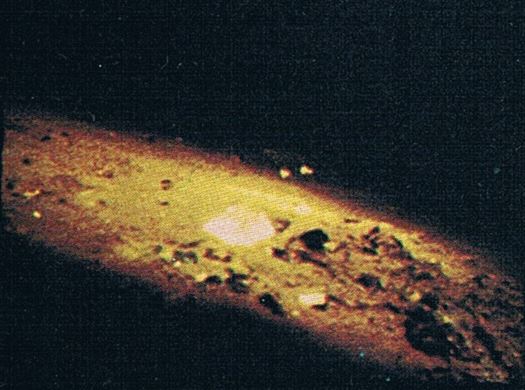


It is evident that there are differences between the surface of the image in question and the loch bed. The silt that accumulates on the loch bed basically gives it a smooth appearance which is punctuated by the appearance of rocks, branches. rubbish and so on. The rough textured surfaces gives no indication that any silt is present there or indeed objects such as rocks and branches. In fact, when I first saw the image I thought it looked more like the surface of the moon from a satellite!

I would also suggest the presence of the gouges on the image to the top left and top right dictate against a silted surface as the volatility of disturbed silt will not leave such sharp features. I say this in anticipation of suggestions that the gouges are produced by the camera rig dragging along the surface. The other point to make is that if this was the bed of the loch, it is almost as if it was a plan view of the surface, as if the camera rig was parallel to the bed hovering a few feet above it. That does not seem a likely scenario. If the camera was going to be parallel to the surface, it would be face down and probably in a cloud of silt.

However, the clarity and quality of the image under scrutiny is clearly superior to the other images which begs the question as to what circumstances allowed this to happen? Why is the image so sharp and detailed compared to the loch bed images? It could be because it is in a silt free region such as mid-water, thus aiding clarity or it may be a lot closer thus reducing attenuation of detail by the volume of water between camera and object. 

Or perhaps it is an image of the camera pointing up at the disturbed waters of the loch surface? The image below is of the loch surface during those days when the camera was titled up. Clearly, this lacks the clarity, detail and texture of the image and thus we should discount the surface of the loch as an explanation. The one remaining explanation related to the loch bed is the possibility that the camera rig did not hit the bed but had rotated in the water to face the loch wall. 


This is a theoretical possibility, though the sides are not vertical but slope to varying degrees. I could not find an image which shows the sides of the loch underwater in close detail, but I doubt the sides would look like this image since I still expect silt to lie inside clefts and indeed expect gravity to ensure surface features are more vertical in appearance. Nevertheless, I will keep this view on hold until suitable side wall images turn up.

But there are arguments against the image. One is that it has been accepted that the image described by Witchell was the loch bed image previously shown which we show again below. This was actually printed in the MIT journal, Technology Review, in March 1976 which discussed the 1975 images and was interpreted by the AAS as a cylindrical object ten feet away but they made no mention of parasites or anal folds. Now it could be that image, though I see nothing to the left to suggest an "anal fold" and the proposed creature would be swimming upside down, though this is not unheard of in the marine world. Then again, what should an anal fold look like? What did George Zug have in mind? Nevertheless, I can see features in both photographs which line up with Witchell's description. Obviously, the most expedient solution is to ask the man himself.


Now if this was the rough skin of the Loch Ness Monster, then it would be an astounding win for Rines and the Academy, but some questions have to be answered before we go that far though the rough texture of the surface evokes various thoughts, as it did with those zoologists back in 1975. My curiousity was aimed at the almost star shaped scar or gouge to the top right. Is than an animal like feature or something else? Also, the superior clarity of the image may be so good as to mitigate against it being taken by the same camera.

But no sooner was this picture possibly mentioned by Witchell and perhaps Meredith in his book, "Search at Loch Ness" than it disappears from view, if indeed it ever appeared in the public space. And therein lies the biggest problem concerning this image, if it was believed to be the underbelly of the creature, why was it not published? Robert Rines ought not to have passed up on such an opportunity. 

The fact that the curator puts a question mark against it being from Loch Ness and has no date for it should make us pause before going further. Indeed, this article is probably more an appeal for further information to corroborate this picture than claiming it is the monster. I can confidently say it is not a photograph of the loch bed of 1975, it is something else. It may have been taken during that expedition or maybe another year or at another spot at Loch Ness or maybe not at Loch Ness at all. The bottom line is that more information is needed to determine the provenance of this photograph. If that comes, a follow up article may be required.

The original image can be viewed at the MIT archive here.


Comments can also be made at the Loch Ness Mystery Blog Facebook group.

The author can be contacted at lochnesskelpie@gmail.com


Friday, 12 August 2022

Upcoming Loch Ness Monster Talks


Let me update you on a couple of upcoming talks related to the Loch Ness Monster in chronological order. First up is a talk by Charles Paxton next Tuesday organised by the Edinburgh Skeptics as part of their Edinburgh Fringe meetings. The talk is described above which he tells me will refer to the beast at various points. You may wonder why I am promoting a talk by a skeptical society and indeed, Charles himself does not believe there are any large animals in the loch. However, I am interested in how he will define the gap between science and pseudo-science in the context of the search for unclassified animals. That is a conversation all cryptid hunters should engage in rather than reject it just because zoologists don't go near their chosen subject. The talk is free at the Banshee Labyrinth Pub just off the Royal Mile at 7:20pm, first come, first served with a donation encouraged.


The next talk is more for believers in our favourite cryptid. On the 29th October, Malcolm Robinson will deliver a lecture on the Loch Ness Monster as part of his monthly series of talks on mysterious subjects. Malcolm will be known to readers as a leading UK paranormal and UFO researcher and author of various books on those subjects - including one on the Loch Ness Monster shown below. Indeed, Malcolm is not long back from a trip to Loch Ness looking for its famous denizen.


The talk is in the town of Sauchie, about five miles east of Stirling. Further details of the meeting are in the promo image above and I have already booked my seat. I also aim to be at Charles' talk, so it should be a series of interesting events all round.


Comments can also be made at the Loch Ness Mystery Blog Facebook group.

The author can be contacted at lochnesskelpie@gmail.com


Saturday, 30 July 2022

The Statistics of Nessie Sightings


Is the study of the Loch Ness Monster a subjective or objective matter? I suppose the answer has to be both when one considers what the particular focus is. Photographs and films can be considered objective evidence although the interpretation of each item can be considered a mix of the subjective and objective. Likewise, eyewitness accounts are objective but again the interpretation is often in the eye of the beholder.

However, in all of these there is usually a collection of quantifiable data points than can have statistical techniques applied to them. For the next few articles, we shall have a look at some of these in no particular order. When it comes to the Loch Ness and large enough statistical datasets, we are mainly talking about eyewitness accounts which can be subdivided into a variety of metrics related to time, motion and dimensions.

The database I use is an augmented version of one based on the work of Charles Paxton and consists of over a thousand accounts divided into various sub-categories. By way of example, I will open up with a dataset that one would expect to be Nessie-agnostic, in other words, no correlations may be expected. In this case, I am using the day of the month on which individual eyewitness accounts happened. Using the total dataset, it was ascertained that 639 accounts had a complete date associated with them. The number of reported sightings on each day from day 1 to day 31 is shown below.


The expected average over days 1 to 31 is 20 sightings. However, there is a slight skewing of the data as four months have 30 days, seven have 31 and one has 28 or 29 days. So it is no surprise that the 31st has the lowest count of 10, but the 2nd comes in just behind at 11. However, the data is quite varied about that average of 20 reports, ranging from 10 on the 31st to 32 on the 27th. Does this mean Nessie is more disposed to putting in an appearance on the 27th of any given month or that more eyes are on the loch on the 27th of the month? Or is it just a random effect of the data?

One way to approach this statistically is by calculating the normal (or Gaussian) distribution curve for this dataset. This curve basically shows the distribution of data points around a mean value. For example, in a set of student exam marks, we may find that most students score a C grade at the peak of the bell curve while one half of the curve are the higher grades which tail off to the end where a small number achieve an A+ and on the other side of the curve the low achievers tail off to the small number who get F grades or worse.

Given enough data points, it is found that these bell curves occur in many areas of society and nature. This dataset of Nessie reports is no different as it produces a nice normal distribution below centred around the peak of the average of about 20 sightings per day of month. We see it also tails off towards the extremes of a high or low incidence of reports for the days mentioned above. This suggests the distribution of sightings is within statistical norms.


However, one further confirmation of this is the so-called "68-95-99 rule" which is a heuristic (or approximate rule of thumb) which states that:

68% of the data is within 1 standard deviation of the mean.

95% of the data is within 2 standard deviation of the mean.

99.7% of the data is within 3 standard deviation of the mean.

The standard deviation of a set of data points is a measure of how much the data varies from the mean or average value. The higher the variance, the higher the standard deviation value. The value of the standard deviation for this population of data points is 5.35. Applying the 68-95-99 rule, vertical lines are usually drawn at the 1st, 2nd and 3rd standard deviations (or sigmas). The 1st, 2nd and 3rd deviations are calculated by adding or subtracting 1, 2 or 3 times the standard deviation of 5.35 from the mean of 20.6 on either side of the peak.

Thus we should have 68% of the data within the 1st deviation or between the vertical line values of 15.3 and 26.0 and 95% of the data between the values of 9.5 and 31.3. In this case practically all the data is within the 2nd standard deviation. Statisticians tend to only regard data points as being significant or out of the normal if they go beyond the 3rd standard deviation (here between 4.6 and 36.7). None of the Nessie data points get near the 3rd deviation and so we conclude nothing of statistical significance is notable here. For example, if a third of all sightings had occurred on the 15th day of the month, then we would have had something to scratch our heads over.

But one might venture to say that the dataset is corrupted by accounts which are not sightings at all but are misidentifications and hoaxes. Will this not skew any analysis of the data? After all, do not experts claim that 90% of all monster sightings are explicable by known and unremarkable phenomenon, either natural or man-made? The quote below is from one of the leading Loch Ness Monster researchers, the late Roy Mackal, who wrote this in his conclusion at the end of "The Monsters of Loch Ness":

The realization that surface observations are rather rare has developed gradually over the years. The number of recorded reports during the 30-year period following 1933 was roughly 3,000. This figure, taken at face value, would mean that about 100 observations were made annually. From this it is clear why it was reasonable to expect photographic surveillance of the loch surface to produce evidence rapidly. However, as noted, a more careful examination of the reports tells us that a large proportion of these observations, perhaps 90%, can be identified as errors, mistakes, misinterpretations, and, in a few cases, conscious fraud.

In my opinion, this 90% statistic is as meaningful as saying nine out of ten cats prefer Whiskas. Firstly it is based on a premise that about three thousand sightings were recorded between 1933 and 1963. The database I use has been thoroughly researched and it lists about 570 unique reports over that period or one fifth of the claim by Roy Mackal. Where can these missing 2430 reports be found? I doubt they all exist and I cannot tell how this number was arrived at. Perhaps some were low grade LNIB eyewitness reports. So, perhaps the 100 observations per year that made Roy Mackal conclude a paradox and led him to a 90% reduction is not so paradoxical when it now reduces to 20 observations per annum over that thirty year time span.

I would add the caveat at this point that the original author of the database I use may have found 3000 reports and culled them. I know he excluded such dubious items as Frank Searle's accounts, but 3000 sounds unlikely. Secondly, this ninety odd percent assertion is something that occurs elsewhere and seems to just be a number symbolic of human error and the triumph of scepticism. The number was repeated again by LNIB member Clem Skelton (see link):

Skelton figures that eighty to ninety percent of the people who think they have seen the monster have really seen something else.

It gets worse as the same numbers appear in Bigfoot research (see link):

... even those who research Bigfoot will admit that roughly ninety-five percent of Bigfoot sightings are either mistakes or purposeful hoaxes.

Imagine that, a completely different phenomenon with completely different explanations, yet they come out at about 90% as well! And let us not forget the UFO phenomenon where, you guessed it, nine out of ten cats, I mean debunkers, prefer swamp gas and the planet Venus (see link):

UFO reports -- 90 percent explained; scientists say rest should be investigated 

Perhaps if it said often enough it will be believed. The truth of the matter is that as the observational qualities of the report deteriorate, the curve of natural explicability approaches the 90% range in an asymptotic manner. Deterioration can mean increasing distance, decreasing time to observe and assess or poor weather conditions, light levels and so on. It would be naive to claim that 90% of all reports seen at 100 yards are as easily explained as 90% of all reports at one mile away. I hope I have made my point, but having said it, a certain percentage of the total claimed sightings will be in error. What is that percentage?

No one knows and let us leave that guesstimation to personal opinion rather than being dogmatic about it. In that light, an attempt should be made to extract a subset of sightings which can be regarded as error free as possible. So we go back to Roy Mackal, who in the same book, tabulated a series of 251 reports he regarded as the best up to the year 1969. On page 84 of the paperback edition, he says he extracted them from the three thousand aforementioned reports. I have made my comment on that, but I will largely take these 251 sightings as of a higher standard and graph them. I say "largely" as the St. Columba account is included, but not surprisingly, the day of the month for this encounter is not given. The graph using the Mackal data is shown below.


We have 138 out of the 251 reports supplying a date or 55%. Does this graph bear any similarity to the first one now that the quality has been increased? One can see similarities such as the expected dip on the 31st and again the count for the 2nd is very low, but there are also divergences. Going back to statistical techniques, similarities in data sets can be quantified using a correlation function. The one I will use is the Pearson correlation coefficient formula. If the coefficient approaches a value of 1 then the two data sets are increasingly similar. If the value approaches 0, there is less similarity between the two. If the value goes past zero to approach -1 then the two are more negatively correlated, or a mirror image of each other.

The correlation coefficient for the two data sets turns out to be 0.32 which means they are not particularly correlated. Does this mean anything? Given that we are examining the Nessie-agnostic day of month, it shouldn't and we are looking at one set of random data against another. The normal distribution graph for the Mackal data is shown below.


This distribution is not as smooth as the larger data set which we can perhaps put down to the lack of data points compared to the other. If a data set gets too small, statistical analysis becomes less reliable. However, the lines indicating the 1st and 2nd standard deviations once again show that the data is within normal bounds and there are no anomalies here.


CONCLUSIONS

We deliberately started this series of articles with a data set which should bear no relation to monster or people activity. There is no theory that either should be more disposed to one day of the month over another, apart from the slight dip expected on the 31st. In other words, it should be data which varies around its average conforming to normal statistical techniques and this has been confirmed. So we can go forward with some confidence in the tools tried out. In the next article, we shall look at data more relevant to the statistics of Loch Ness Monster sightings.


Comments can also be made at the Loch Ness Mystery Blog Facebook group.

The author can be contacted at lochnesskelpie@gmail.com


Monday, 4 July 2022

Marmaduke Wetherell makes a Film


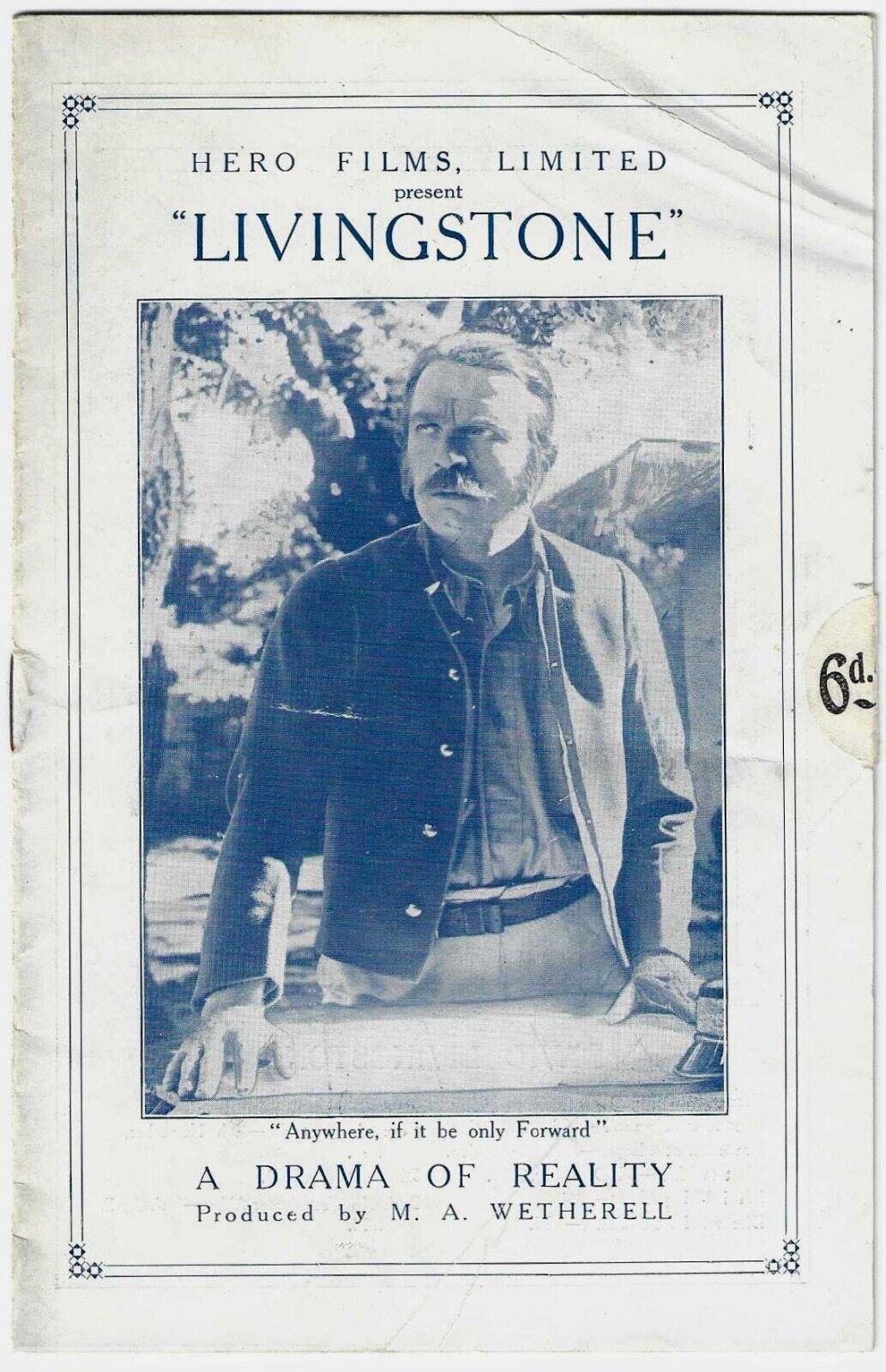
Before Marmaduke Wetherell engaged in his most famous production - the Surgeon's Photograph of 1934, he was in the African continent making another production, though this one was more based in fact being the story of the 19th century missionary, David Livingstone. The image above is the front cover of a promotional magazine from 1925 shows Wetherell playing the lead part. I saw the item on eBay which describes it thus:

Programme for one of the (presumed) first British screenings of the silent movie Livingstone, directed by “Duke” M. A. Wetherell, who also played the title role, David Livingstone the explorer of Africa. (For more on Wetherell and the Loch Ness Monster, see below) The film opened in the UK in January 1925, and though the programme has no date or venue it was certainly produced at around that time. The cover has an image of Wetherell as he appeared in the movie and the 5.5” x 8.5” programme is stuffed with information about the life and expeditions of Livingstone as well as the making of the film in October and November 1924. It includes a cast list, photos of film scenes, and even photographs and biographies of two African performers, one of whom claimed to have been Stanley’s servant as a boy, and therefore present at the actual meeting between the two men in November 1871. Eleven of the twelve pages are devoted to film-related content, with the only advert being one for Osram light bulbs on the back cover. In fair condition, the programme has some creases but is clean and bright. A very rare programme indeed.

* M. A. Wetherell was the hoaxer behind the famous “surgeon’s photograph” of the Loch Ness Monster. Details can be found on the Monster’s Wikipedia page, but it is interesting to note that the photo was actually taken by Ian Wetherell, who played David Livingstone at age 10 in the movie Livingstone.

Here is a picture of Wetherell from that magazine which tells us he had spent fifteen years in Africa up to that point. It made me wonder if he had ever heard of the mysterious Mokele-Mbembe of the Congo being the big game hunter he claimed to be. Then again, Africa is a huge place, and him being in Rhodesia must have put over a thousand miles between him and that cryptid.


Another player in the Surgeon's Photograph drama was his son, Ian Wetherell, who took part in the taking of the model photo at Loch Ness. As it turns out, he is in this film playing a young David Livingstone as shown below. Another person mentioned in this magazine is Gustave Pauli, who is credited with the photography. Now some may remember him as Wetherell's cameraman when he mounted his Daily Mail expedition to Loch Ness in late 1933. He is shown below with his beret on with his camera at the ready beside Wetherell at the loch. The location is Dores Beach on the pier which is now just a number of decaying posts sticking out of the water.


A thought passed my mind on the matter of Pauli. He had been at Wetherell's side since at least 1925 helping him with photographic matters. So he would seem the natural choice to get these monster pictures properly processed with the minimum chance of error. Not much is known about him and perhaps he was an honest man who would have nothing to do with Wetherell's planned revenge upon the Daily Mail. 

The eBay item can be viewed here.


Comments can also be made at the Loch Ness Mystery Blog Facebook group.

The author can be contacted at lochnesskelpie@gmail.com


Sunday, 19 June 2022

Arthur Grant's Wall


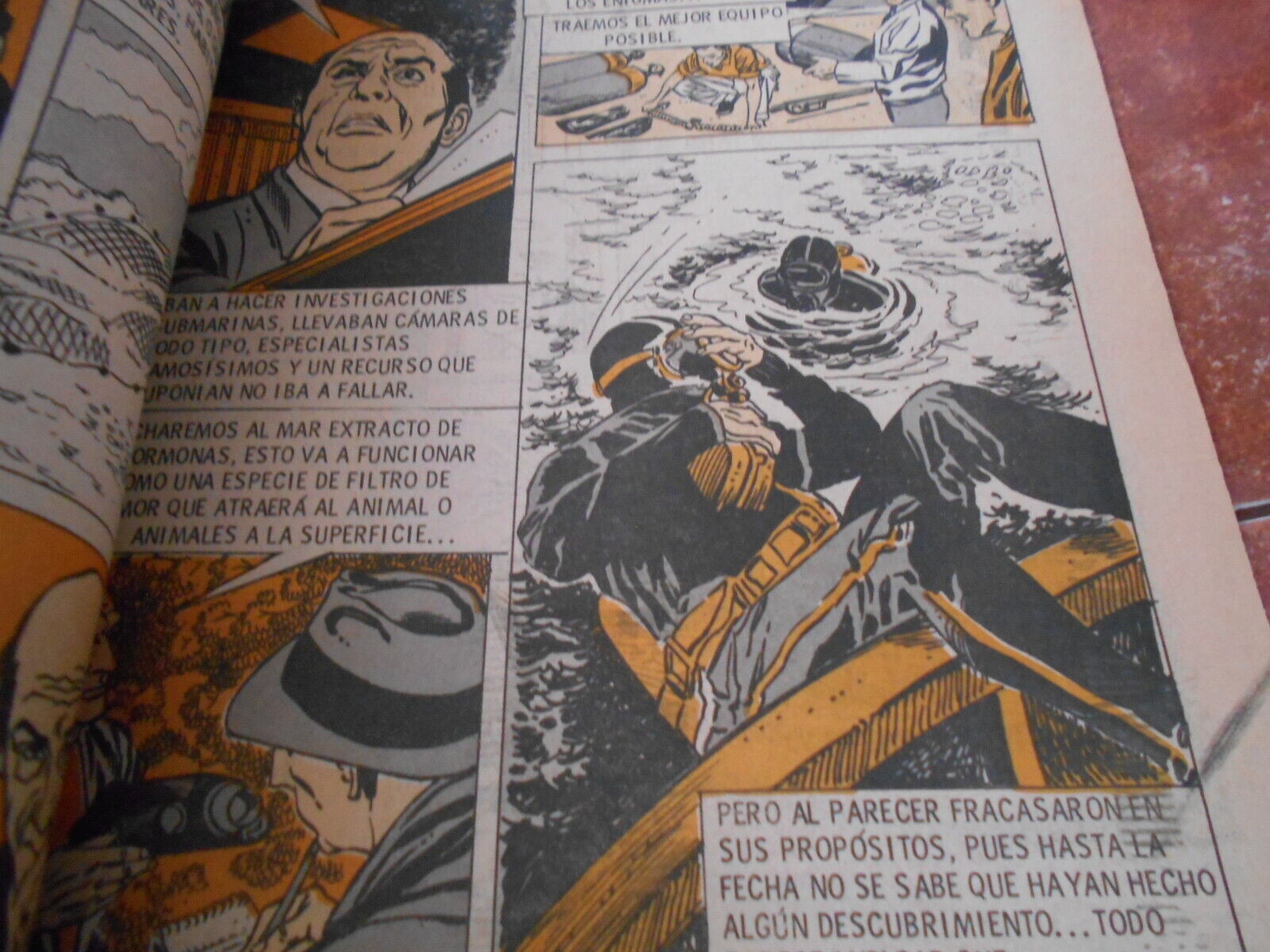
Its a funny old world sometimes. Just a couple of weeks after posting on Arthur Grant and whether our favourite beastie had to negotiate a wall to get back to the safety of deep waters, something turned up on eBay. It was a Mexican magazine called Duda issue No.9 from July 1971 devoted to the subject of the Loch Ness Monster. The title "Duda" means "Doubt" in Spanish and they seemed to have published on various mysteries from all parts of the world over the years. A look at the pages displayed on the listing showed that the author had included the Grant case as you can see below.


As was the case with these illustrated magazines, they did like to go a bit beyond what had been reported in the original testimony from the primary source newspapers of the time. The more dramatic the picture, the better the sales I guess. Here we see Arthur Grant fully kitted out in motor cycling gear, leather boots, goggles and all. The creature itself is more threatening than what Grant described with human chomping teeth included. I suspect Grant is a bit too close to the creature here for his own good.

But then the wall appears and the creature clambers over it. The translation from the Spanish reads "and awkwardly climb the wall that separates the road from the loch". One would be interested to know what the magazine's source material was for this account as none I know of mention a wall. Either way, their version of Nessie with powerful hindquarters knows how to get over a wall.

A bit of a fun coincidence. Maybe someone can translate the Spanish and I include the other pages I saw and wonder what report they are referring to when the monster pops up in front of a man in a boat. The one from 11th July 1935 in the adjoining Loch Dochfour is the Mrs Gerald McGrath head and neck account from 11th June 1935 which I include at the end from The Scotsman of the 12th June. The description of two rows of fin like "excrescences" refers to some kind of abnormal protuberances which is quite curious and difficult to envisage without a sketch.


Comments can also be made at the Loch Ness Mystery Blog Facebook group.

The author can be contacted at lochnesskelpie@gmail.com


Monday, 6 June 2022

Interesting selection of Cryptozoological items


Just a quick note to refer readers to a long listing of dozens of Loch Ness Monster books and other cryptozoological items on eBay just now by seller roman10818. I don't think I have seen quite a good collection coming under auction from just one seller in my years of watching eBay. The listings include books from Gould and Oudemans in the 1930s right up to the present day and they can be found here.

Now I admit I own practically all of the Nessie items but I have been scouring the book landscape for decades. One item I did not own was an original copy of Frank Searle's unpublished "Loch Ness Investigation: What Really Happened", presumably posted out by Searle. I only have a photocopy given to me by one of Frank's supporters back in the 1980s. 


The author can be contacted at lochnesskelpie@gmail.com


Wednesday, 1 June 2022

Arthur Grant meets a Wall of Scepticism


I have to say that Arthur Grant is one of my favourite accounts of the Loch Ness Monster. A giant creature lurching across a lonely road under a full moon before a befuddled motor cyclist? What's not to like? Of course, the dramatic story line makes some think it is just that - a made up story. I cover this account in my book, When Monsters Come Ashore, and will no more than quickly reproduce some words from the time to bring you up to speed. The event happened in the early hours of the 5th January 1934.

"It was," said Mr. Grant, "a bright moonlight night after rain had fallen. When almost forty yards away under the shadow of the hills, a short distance from the part of the reconstructed Glasgow-Inverness road near Abriachan, I observed what appeared to be a large black object on the opposite side of the road. I was almost on it when it turned what I thought was a small head on a long neck, and the creature, apparently taking fright, made two great bounds  across the road and plunged into the loch.

"I had a splendid view of the object; in fact, I almost struck it with my motor cycle. It had a long neck with an eel-like head and large oval-shaped eyes, just on the top of the small head. The body was very hefty, and I distinctly saw two front flippers. There were other two flippers, which seemed to be webbed behind, and there was a tail, which I estimate would be from five to six feet long. The curious thing about the tail was that it did not, so far as I could see, come to a point, but was rounded off. The total length of the animal would be from 15 to 20 feet.

"Knowing something about natural history, I can say that I have never seen anything in my life like the animal I saw. It looked like a hybrid. 

"I jumped off my cycle," said Mr. Grant, "but the animal with great speed had rushed into the loch, splashing the surface violently and making away."


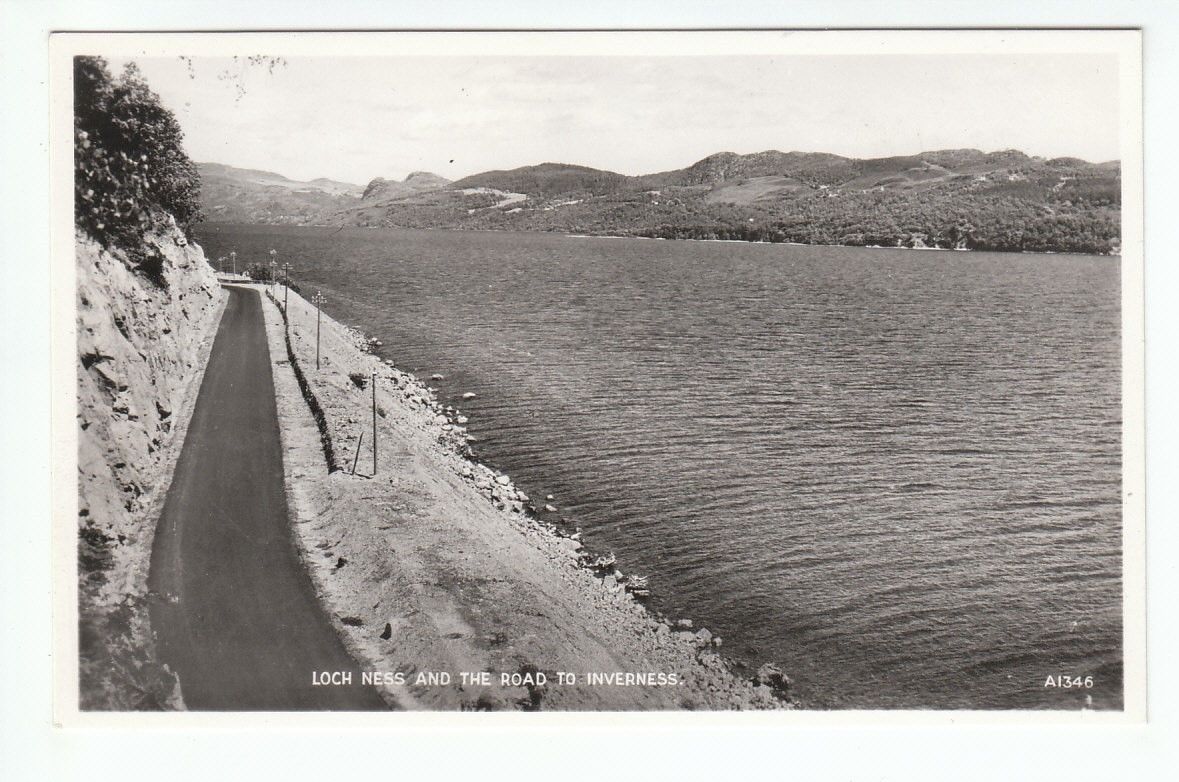
Having written the chapter on this event, it is never wise to close the book as things always turn up for further discussion and insight. For example, news of a three toed cast found back then came to light after I wrote the book (see link). Today, the focus is on addressing another attempt to discredit this account by sceptics. In this case, pictures of the then newly developed Glasgow to Inverness have been posted with what is claimed to be an important feature - walls. One is shown at the top and another below and they were part of the completed construction of the new road running for miles.


If you wonder what walls have to do with this case, then the implication is that if there was a wall in front of the alleged Nessie, it would not have got over it. Ergo, Grant lied and the sceptics can remove another famous case from their hit list (though I suspect they think they have done that already). Now by my estimate, these walls could be up to two or three feet high as they seem to vary. It is not clear if there was a consistent height depending on the situation or risk at that point by the shoreline. One can still see them today in various states, some missing stones or covered in vegetation and so on.

The first question to ask is whether our creature could hurdle such an obstacle? That depends entirely on what kind of species the animal is and so we could go off in different directions speculating on our own favoured beast. Could a mammal such as a long necked version of a seal get over such a wall? I would say yes going by this video clip of a much smaller seal negotiating an imposing rock of similar height to the walls by Loch Ness. One would think a larger pinniped would have less trouble getting over.

Could a plesiosaur negotiate it? Now you're asking a question. Are you talking about the ones preserved in the fossil record or the evolved one popular in the 1970s? When a plesiosaur is proposed to have evolved, there is no end to the adaptive qualities one may add to achieve ones ends. Well, I see no reason why it couldn't, but I am not being authoritative on that matter. And so we may go through the list of candidates.

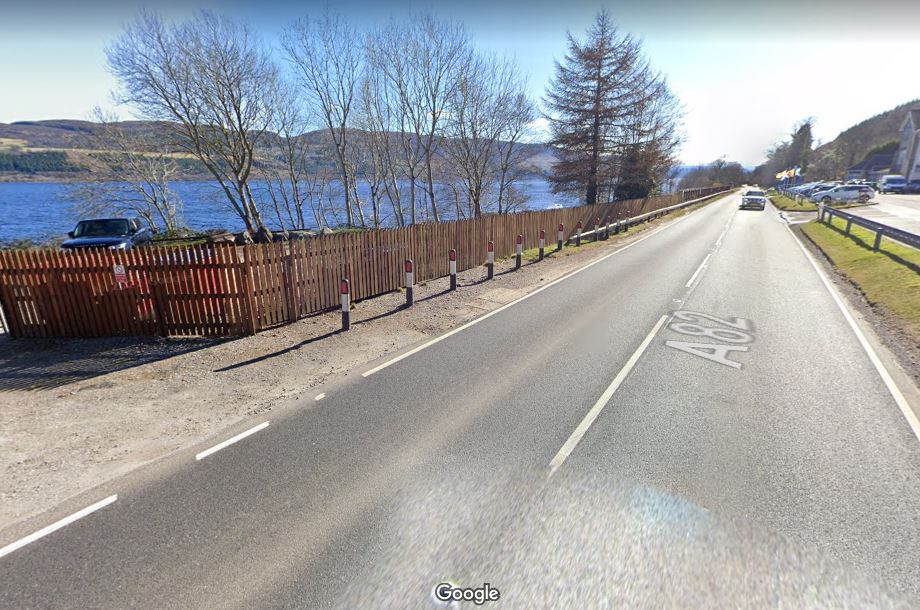
But one may cut through this and say if the creature managed to get out of the loch, get on to the road and over it then surely it can retrace its route in reverse with similar skill? One can see the logic there, though another may retort that it may have disembarked at an easier point further away. Such is the cut and thrust when information is lacking. But another observation may come to our aid. As explained in my book, the location of the Arthur Grant encounter is almost certainly along the stretch of road now occupied by the Clansman Hotel. The Google image below shows the hotel and note the green Nessie statue to the left conveniently reminding us of the event nearly ninety years before.


A look around shows a lack of walls such as this shot where the only visible wall bridges over a stream. Obviously, the metal barriers are a modern addition. The second image is looking the opposite direction towards the south and you can see the entrance to the pier where various vessels such as the Jacobite tourist cruisers pick up passengers. One would surmise that a brick wall is less likely to be found at a pier as it would hinder access for vehicles and if a boat had to be towed onto land.


A look at contemporary ordnance survey maps may help us here. The first is the one inch per mile (1:63360) "Popular" edition published from 1921-1930. You can see the pier clearly marked and note that the red road is delineated by either solid black line or dotted black line. According to the symbols of the time, the solid line with a red road indicates a main route between towns but if it changes to dotted line then it is an unfenced boundary. The road goes from solid to dotted as the pier approaches and for a distance after before going solid again. We can take it that this means any wall disappears to accommodate access to the pier. This stretch of unfenced boundary is where I think Grant encountered his monster.


However, this map was published in 1929 and Grant himself refers to the reconstructed road in the account above five years later. Did that result in a wall being constructed near the pier? A look at another map from 1940 says not. It is a military map at at scale of 1:25000 and the broken/unbroken lines follow much the same pattern. So no wall along the shore and I think we can dispose of this sceptical objection.


Of course, other objections to the Arthur Grant land sighting have been made over the years. The arrival of Marmaduke Wetherell at the scene gave sceptics the opportunity to play the guilt by association card. However, an expedition led by Mr. A. F. Hay, a Fellow of the Zoological Society of Scotland, visited the site and their report was published by the Scotsman newspaper. They had examined the road and beach and proposed a walrus was the best candidate. Curiously, they did not mention anything about walls getting in the way and I have no reason to doubt this was because there was no wall there.


Comments can also be made at the Loch Ness Mystery Blog Facebook group.

The author can be contacted at lochnesskelpie@gmail.com


Monday, 2 May 2022

A Recent Video Examined


A few days back came the latest video published by the Daily Mail of a wake filmed by an anonymous couple from above Urquhart Castle at about 6am on the 25th April. Below is the relevant text from that article:

The woman had woken up just after 6am on Monday and decided to take some photographs as the loch was so still that its surface was like glass. But after spotting something large moving in the water, she began filming on her iPhone and could be heard saying ‘What on Earth is that?’ as her husband joined her to watch what was unfolding. The couple filmed for two minutes and 37 seconds from 6.21am as the mysterious creature – they estimated it to be between 20 and 30 feet in length – swam beneath the water and gave them tantalising glimpses as it broke the surface.

It appeared to have at least one fin or limb, which paddled under the water ‘like an oar’. The woman also took several still pictures from the vantage point of their holiday cottage set on the hillside opposite Urquhart Castle, around a quarter of a mile from the loch. She added: ‘I really don’t know what it was in the water. It was something large. I don’t think it really equates on the video quite how large it was. ‘We don’t know what the creature was. It was propelling itself with something. It wasn’t how a fish would do it.

‘You could see it much clearer than it’s come out in the photos. The lumps or humps or whatever they are kept disappearing under the water, but it was still pushing forward under the water. ‘You could see something under the water, then it rushed forward and turned round. From what we could gauge, it was between 20 and 30 feet long. There was nothing else on the loch, no boats, nothing.’

The shot below with the castle in the foreground gives some context. Now when I read the headline that it was a double hump film and the best footage for twenty years, I thought I have to see this. But as they say, the trailer is often better than the film and I was disappointed with what I saw. In fact, I struggled to see much detail in the mobile camera clip. We are told they were high on a hillside about a quarter of a mile away from the loch.


And therein lies the problem, they were in a comparable position to the controversial webcam clips that have regaled newspapers in recent years. Though admittedly, the resolution of this is a bit better. I believe this is a 640x360 resolution (at 25 frames per second) and it looks like the webcam is 480x360 and so the couple's video has about 33% more information. This is not much compared to the webcam, though I suspect the original iPhone video would be higher, perhaps 720p. If so, an investigation is incomplete without seeing this original file.

Now the image at the top of the article is taken from the Daily Record presumably was a highly zoomed in frame from the video. I say that because we also learn that some photographs were taken by the lady and I suspect they may provide more detail than the video. At this point, I do not have access to these and again the investigation may be incomplete without them. However, if this is an enlargement of a photograph, then perhaps they are not that useful.

But what we see in the top image is interesting in that the two dots are behind the bow of the wave which is being generated by something else. In fact, there appears to be nothing at the head of the wave. Clearly there has to be something there and the conclusion is that whatever it may be is lost in the pixellation.

We have the video and there are photos, but we must not discount the naked eye testimony as others are wont to do. The eyewitness said what they saw with the eye was superior to what was recorded and that I can agree with. The human delivers something which no camera can. In that context, some details come out:

It appeared to have at least one fin or limb, which paddled under the water ‘like an oar’. ... The lumps or humps or whatever they are kept disappearing under the water, but it was still pushing forward under the water. ‘You could see something under the water, then it rushed forward and turned round.

Nevertheless, they were still a quarter of a mile away or about 400 metres. This is not a great distance - unless a thirty foot creature wholly breaks the surface with a double hump and long neck display and goes on a swim for a good few minutes. But certainly, going by the video alone, nobody could conclusively identify what is in the sequence - unless somebody comes forward and confesses they had a vessel or something in that area at that time. However, the lack of detail in the video should not be taken as a reason to discount the naked eye testimony.


Comments can also be made at the Loch Ness Mystery Blog Facebook group.

The author can be contacted at lochnesskelpie@gmail.com


Tuesday, 19 April 2022

The Usse of North England


Here is a clipping from the Cleveland Standard dated May 5th 1934. The news of a monster in Loch Ness brought out various interesting stories from the end of 1933 onward as some newspapers vied for attention bringing up stories about their own local monsters both past and present. This one goes right back to the 17th century for one of oldest tales that I have come across. Here is the text of the article:

Just an Usse!

I have just come across something which will make the Loch Ness Monster wish he had never seeen the light of publicity. It is an Usse. There is recorded in an old 17th Century volume I was looking at the other day an account of a queer monster stated to have been found at Coatham back in 1615. The entry reads:

October 28. Being Satterday, 1616. In Teasmouth, besides Cotham, in the Countie of Yorke, came ther to land a mightie ffish, the length whereof was 19 yards. The bodye in compass 20 yards. Betwixt the eyes four yards with 32 teeth as big as one's arme, long 9 inches. In coloure like the blewe sky. Skynn without skaylis with haire like the seale. The same (as some may yt having seen such fish) is an Usse. Sir Henry Bellansys having the title and right to all sea wrecks and pisces regale from Runswick to Yarme, sold the cyle and parmasetye to one John Whyte, of Cotham, for £120.

And now we know!


The town of Coatham is located near the modern city of Middlesbrough and the creature appears to have been stranded at Teasmouth or in or near the estuary or mouth of the River Tees. The location is shown below in two maps.


One can certainly imagine big fish stories coming from the East of England bordering the North Sea. But what of this strange beast called an "usse" by this narrator from over four hundred years past? So we have a beast almost sixty feet long, which excludes a lot of candidates right away. The "compass" of twenty yards we presume to be the circumference, in which case if it was a circular body would equate to a diameter of 6.4 yards or nineteen feet across. So the length to diameter ratio perhaps was three to one indicating a bulbous body.

However, no mention is made of our typical long tail or neck associated with the Loch Ness Monster. In fact, perhaps in the manner of a catfish, we have a great gash of a mouth four yards long dominating the front of the beast, which was not far off our suggested body diameter of six yards. Add to this the teeth each of nine inches and we have a formidable beast. With blue skin like that of a seal, what could it have been?

The fact that this was deemed a rare find is shown in the fact it was sold for £120, which is over £30,000 in today's money. This suggests this was something that didn't arrive on those shores very often. In fact, a clue lies in the word "parmasetye" which equates to our modern word "parmacetti" which I am told "is the pearly white, waxy, translucent solid, obtained from the oil in the head of the sperm whale: used chiefly in cosmetics and candles, and as an emollient."

What the other material named "cyle" is I am not sure, but we seem to be in the realm of toothed whales such as the sperm whale, whose teeth indeed can reach up to nine inches as a maximum and sixty feet is easily achievable as a length. They can also be blue-grey in colour. So perhaps not such a competitor to Nessie as first suggested.

As for that old English word "usse", that is the mystery to me. The word "whale" was already in use at that time. In fact, the King James Bible, published at that time uses the word "whale" when referring to some large sea creatures. So why didn't they just refer to it as a whale? Perhaps it was a local dialect used by people from that region? Suggestions are invited in the comments.


Comments can also be made at the Loch Ness Mystery Blog Facebook group.

The author can be contacted at lochnesskelpie@gmail.com


Tuesday, 12 April 2022

Day Trip to Loch Ness


It was a quick trip to the loch this Sunday as I got up at 0630 in Edinburgh and arrived at the village of Inverfarigaig by about 1030. Surprisingly, I was greeted by patches of snow around the outer lying villages, though the loch seemed pretty clear. I also had to dodge an unusual number of cyclists until I realised the Loch Ness Etape cycle race was coming soon and there was plenty of practise runs going on.

The day basically consisted of watches from four areas. The first was near the Wall which is less than a mile on from Inverfarigaig at a parking spot where I sometimes like to watch the loch from. The loch surface was pretty calm as the sun occasionally broke out from the clouds but it stayed dry. From there it was a drive of a few miles to the second spot at Whitefield and the beach where Lachlan Stuart took his famous three hump photograph in 1951.

I walked for a long distance south crunching through myriads of pebbles keeping an eye on the loch but also the low lying branches that sprouted towards the loch. There was what looked like a big black water tank lying on the beach. Did it come from the road or from the loch? It was a bit hard to say either way, I suspected it was fly tipped from the road and rolled down the short hill. Either way, it is a shame that rubbish is too often encountered on the beaches.

Driving onto to the outskirts of the northernmost village of Dores, I disembarked again with camera and binoculars for a walk along the southern side of the beach, heading back the way I had come from towards the salmon farm. Everything was setup for photographing an appearance, but the old girl would not oblige. By the way, here are some tales from the salmon farm, as told by Ally MacLeod on Steve Feltham's Facebook page, here and here.

The salmon farm has had some monster stories over the years. It was not long after this blog started that I covered the interesting picture taken by Jon Rowe (link). The annotated picture below shows the two "protuberances" to the left, the shadowy water and my impression of the back. All speculation of course, but they certainly were not two birds bottoms up. Some suggest this place should be crowded by Nessies trying to get at all those salmon. The only problem with that is the fish are impossible to nab but I always fancied this was a good spot for CCTV or a webcam.


It was then onto Dores and I grabbed the camera and binoculars again and went for a walk along the southern part of the beach. I went down almost as far as the salmon farm but nothing showed despite the ideal conditions for a surfacing. With that I drove on and parked by the Dores Inn and walked along the top part of the beach as far as Tor Point. The forest there has been landscaped to allow tourists and locals to walk along a nice path around the point and onto Aldourie. It was a pleasant walk with various points from where you can go straight to the shoreline. I stopped at one such place and conducted a final watch opposite a point close to Lochend (picture below).


A white cruiser made its way along the opposite shore and the background hills gave the odd impression of being made of two parts with a split down the middle. It was near this walk that a local gave me an account of their sighting with a friend back in August 2018 (link) and one of the sketches is below. I chatted with them but they wished anonymity, which makes me wonder how many sightings are like this because of the reception they may get from sceptics?


As an aside, I had trouble finding the above 2018 report and had to look through the annual reviews which I have now updated up to 2021 and are useful as a kind of index for events since 2012 (link). On the way back, I checked in with fellow monster hunter, Steve Feltham, who was working  on his models. We chatted through the issues of the day such as webcams, the salmon farm and other recent events. I have to agree with Steve that the webcam is done once the paddle boarders came forward as some alleged "mysterious" objects.

I would just say to anyone using this under powered webcam to do some "calibration" and present clips or images of what you identify as known objects be they boats or otherwise. With those provided, they can be compared against what is claimed as "unknown". But to this day, no one down below has corroborated any of these images, so case closed for me. However, we hope for better, shinier, whizzier webcams for all those budding remote hunters to move over to. Just don't expect the same number of mystery hits, people.

With that it was back on the road south and the expectation that I will be back up next month for an extended visit. Good luck to all who endeavour to capture images of that elusive monster in the months ahead.


Comments can be made at the Loch Ness Mystery Blog Facebook group.

The author can be contacted at lochnesskelpie@gmail.com


Tuesday, 5 April 2022

Upcoming Nessie Podcast


I have been invited to speak on the Truth Proof live stream podcast with Paul Sinclair. This will go out live on Thursday 7th April at 7pm GMT followed by a Q&A session as people chip in with their comments and questions for me. Feel free to tune in and make your own contributions. The discussion is expected to be wide ranging across various Loch Ness Monster topics, but will be partly listener driven. Perhaps we will get to hear of some previously unheard of Nessie sightings?

Go this link on YouTube where the livestream will take place in two days. See you there!


The author can be contacted at lochnesskelpie@gmail.com